Mathematics:
For many of us, and especially among young people, Mathematics
is seen as useless and absent from everyday life.
If it is perceived this way, at least three groups are responsible:
- On the one hand, teachers of all disciplines (and particularly in the sciences) maybe do not make the necessary effort,
but do they have the means?
- On the other hand, policymakers who define the broad outlines of educational policies.
- Finally, Mathematics itself. Indeed, it is quite difficult to see the relevance of research dealing with:
|
And yet, a simple story can
make this relevance obvious. Thus, geometry (so-called Euclidean geometry), which is
taught from primary school with its triangles, squares, and so on, is based
on a few axioms.
One of them, the parallel postulate 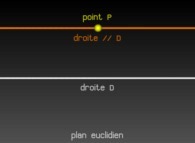 , was in fact, for two millennia,
a conjecture that many tried to prove as a theorem, but in vain. In the mid-19th century,
it became necessary to face the facts: it could only be an axiom (and therefore unprovable).
Several great mathematicians such as Carl Friedrich Gauss, Nikolai Ivanovich Lobachevsky,
and Bernhard Riemann then imagined new geometries by "playing" with this axiom. Physicists,
particularly those studying the universe, thus found themselves with new tools: it was
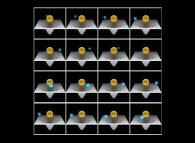
up to them to determine which were useful. And so, in 1915, Albert Einstein published a revolutionary
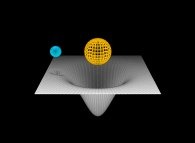
paper, "General Relativity", in which he showed that the four-dimensional spacetime
is not Euclidean: it is a so-called Riemannian manifold whose curvature determines
the trajectories of masses/energies, which themselves produce this curvature: , was in fact, for two millennia,
a conjecture that many tried to prove as a theorem, but in vain. In the mid-19th century,
it became necessary to face the facts: it could only be an axiom (and therefore unprovable).
Several great mathematicians such as Carl Friedrich Gauss, Nikolai Ivanovich Lobachevsky,
and Bernhard Riemann then imagined new geometries by "playing" with this axiom. Physicists,
particularly those studying the universe, thus found themselves with new tools: it was
up to them to determine which were useful. And so, in 1915, Albert Einstein published a revolutionary
paper, "General Relativity", in which he showed that the four-dimensional spacetime
is not Euclidean: it is a so-called Riemannian manifold whose curvature determines
the trajectories of masses/energies, which themselves produce this curvature:
Very quickly, many physicists embraced the theory and in particular Georges Lemaître,
who realized that, despite Albert Einstein's belief, the Universe could not be static.
In 1929, observations by Edwin Hubble (in collaboration with Milton Humason) and Vesto Melvin
Slipher showed that other galaxies appeared to be moving away from us, the Milky Way, at speeds
that increased with their distance, this being seen by a spectroscopic analysis of their light, which shows a redshift in the frequencies.
Therefore, the Universe was not static but expanding,
and if one plays the "film in reverse," it must show a contraction toward a singularity (of
zero dimension and infinite density, within the framework of General Relativity, disregarding
Quantum Mechanics...).
This singularity was nicknamed the "Big Bang" by Fred Hoyle in the 1950s,
intending to mock the theory in favor of his own steady-state model. However, it was later proven
that his model was not consistent with observations and measurements.
General Relativity thus allows for the description of the Universe in its entirety:
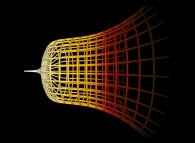
but also of phenomena that are difficult to grasp due to how cataclysmic they are, such as black holes
or gravitational waves:
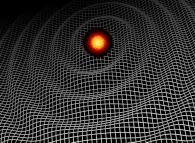
It should be noted that Albert Einstein had predicted the possible existence of gravitational waves, adding that they would probably
never be detected. In fact, it took a century before the two LIGO interferometers in the USA
(in Washington state and Louisiana) "saw" the first ones on 09/14/2015. For me, this is the finest
example of a discovery made thanks to Mathematics, as without them, these waves would
not have been detected by chance, unlike the expansion of the Universe, which could
have been observed "simply" by the redshift of the light from distant galaxies, even if Georges
Lemaître had not yet highlighted it thanks to General Relativity...
|
In our daily lives, General Relativity seems quite useless and far removed from our everyday concerns...
But this is completely misunderstood and ignored by the general public! For example,
GPS, which is omnipresent
in everyday life, relies on measuring space through measurements of time, yet time and
space are intimately linked. Without taking General Relativity into account (as well as Special Relativity...), GPS would be of very limited use!
Mathematics is everywhere in everyday life,
but also, of course, in industry and in the most fundamental research:
without it, for example, there would be no quantum mechanics
and therefore no integrated circuits, and even less so computers and mobile phones.
One cannot escape the feeling that these mathematical formulas have their own existence, that they are more erudite than those
who discover them and that we can extract more science from them than it was input at their creation.
(Heinrich Hertz, XIXth century).
But why is this so? Why such "formidable effectiveness" (Eugene Wigner, Nobel Prize in Physics in 1963)?
And what is Mathematics? In fact, several points of view are possible:
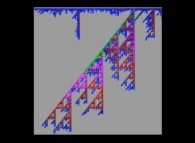
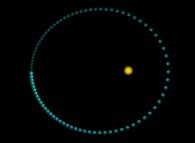
- They are a game of the mind, as illustrated by the conjectures:
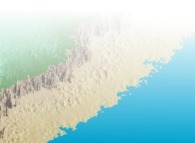
- They offer an unlimited set of analogies:
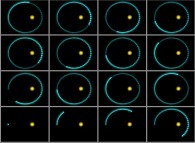
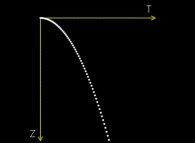
- They compress measurements and bring out new laws:
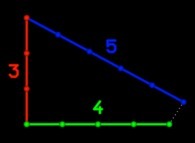
- They are THE language of the Universe (Galileo, 16-17th centuries)
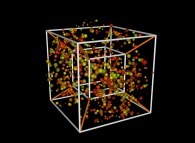
- They are a virtual optical instrument, both microscope and
telescope, opening the way to journeys and discoveries otherwise unimaginable:

- A bit of all this at once?
- What if Mathematics were The Ultimate and Only Reality?
And is the mathematician then an inventor or an explorer? Perhaps both at once:
"God made the integers, all the rest is the work of man(Leopold Kronecker, 1891).
Will we ever know?
COMPUTER SCIENCE:
The great pioneers of computing and its automation were also mostly mathematicians.
- John Neper
( logarithms and the slide rule,
1550-1617),
- Blaise Pascal
(the adding machine -la pascaline-,
1623-1662),
- Gottfried Wilhelm Leibniz
(the multiplying machine,
1646-1716),
- Jacques Vaucanson
(the automatons,
1709-1782),
- Joseph Marie Jacquard
(the loom, a precursor to programmable machines
-first perforated supports: cards et ribbons-,
1752-1834),
- Charles Babbage
(the first computer -mechanical-,
1791-1871),
- Lady Ada Lovelace
(the firts programmer in history on Charles Babbage's machine,
1815-1852),
- George Boole
(the binary algebra {0,1},
1815-1864),
- John von Neumann
(the von Neumann architecture,
1903-1957),
- Alan Turing
(computability, universal Turing machine
 ,
1912-1954), ,
1912-1954),
- etc...
|
Today, the links between Mathematics and Computer Science are becoming increasingly intertwined. This can be
seen, for example, in proof assistants or again with Artificial Intelligence:
and of course in computation. Indeed, having equations and formulas that describe a given system
(industrial or scientific) is not sufficient for engineers or researchers. They need predictions,
and this naturally involves calculations. The days are long gone when Urbain Le Verrier, armed
with nothing but a pencil, spent months calculating the position of the hypothetical planet
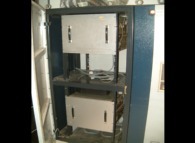
Neptune. The days are also long gone when the early research described here was carried out using a
computer with only 32 KB (!) of memory and two 512 KB (!) disks:
After several years using assembly language
as the sole means of expression (due to the physical limitations of that computer), the arrival of UNIX and then
Linux systems immediately raised the issue of portability. This was addressed through the development
of a complete programming environment that has been used continuously ever since. Three main objectives
were thus achieved:
ART:
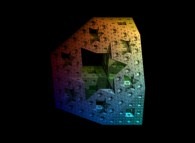
It has always been clear that, in certain purely scientific images, another perspective
could be applied, as is very clearly illustrated by Benoît Mandelbrot
Fractal Geometry:
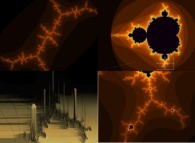
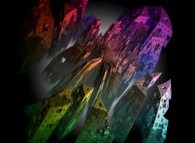
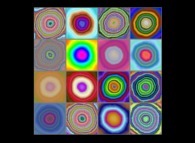
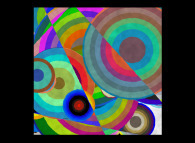
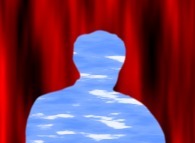
and that the tools thus developed could be diverted for purely artistic purposes and, for example, used
to pay a "mathematical" tribute to some artists of the 20th century:
|
Main Chapters to Explore
[Chapîtres principaux à explorer]
New Pictures and Animations
[Nouvelles images et animations]
Best Pictures and Animations
[Meilleures images et animations]
Most Recent Pages
[Pages les plus récentes]
Most Recently Updated Pages
[Pages mises à jour le plus récemment]
A Quoi Servent et Que Sont les Mathématiques?. | 
Generative Artificial Intelligences and Pictures Synthesis: The Museum of Babel, The Virtual Museum of the 21th Century (A Tribute to a Universal Artist?). | 
A Quoi Servent et Que Sont les Mathématiques? (les Mathématiques, une fenêtre ouverte sur l'Univers et au-delà). | 
Quelques souvenirs personnels à l'occasion du cinquantenaire du CMAP (1974-2014). |
ChatGPT 4o (2024), ChatGPT 5 (08/2025) and beyond: Rapid and spectacular progress in all areas (reasoning, knowledge, imagination,...).
----------
ChatGPT 4o (2024), ChatGPT 5 (08/2025) and beyond: Rapid and spectacular progress in all areas (reasoning, knowledge, imagination,...). | 
Un Environnement Portable de Programmation et de Coopération sur Réseau Hétérogène pour le Calcul Scientifique, l'Analyse Visuelle des Résultats et les Tests de Sensibilité à la Précision des Calculs. | 
From Euclid to GPS.
----------
From Euclid to GPS. | 
Droit de réponse. |
Most Interesting Pages
[Pages les plus intéressantes]
Are you Ready for the Year 2000? [2000: A Data Processing Odyssey].
----------
Are you Ready for the Year 2000? [2000: A Data Processing Odyssey]. | 
The Y2038 bug.
----------
The Y2038 bug. | 
Animation of Fractal Objects. | 
Are Autostereograms Useful for Computer Graphics and Scientific Visualization?. |
Peut-on parler intelligemment et calmement de l'Intelligence Artificielle?. | 
Cantor Triadic Set, Sierpinski Carpet, and Menger Sponge. | 
ChatGPT 3.5 (2023): Myth and Reality.
----------
ChatGPT 3.5 (2023): Myth and Reality. |
ChatGPT 4o (2024), ChatGPT 5 (08/2025) and beyond: Rapid and spectacular progress in all areas (reasoning, knowledge, imagination,...).
----------
ChatGPT 4o (2024), ChatGPT 5 (08/2025) and beyond: Rapid and spectacular progress in all areas (reasoning, knowledge, imagination,...). |
ChatGPT 5 introduces and judges "A Virtual Machine for Exploring Space-Time and Beyond".
----------
ChatGPT 5 présente et juge "Une Machine Virtuelle à explorer l'Espace-Temps et au-delà". | 
The Syracuse Conjecture (the parities of the Syracuse sequence for the numbers 1 to 128). | 
The Syracuse Conjecture (the Syracuse sequence for the numbers 1 to 256). |
From Euclid to GPS.
----------
From Euclid to GPS. |
De L'Enseignement Assisté par Ordinateur à L'Expérimentation Virtuelle. |
God and the Science.
----------
Dieu et la Science. | 
Generation and Animation of Intertwinings, Larsen Effects and more.
----------
Generation and Animation of Intertwinings, Larsen Effects and more. | 
Virtual Experimentation (The place where Art and Science meet together). |
Expériences Virtuelles et Virtualités Experimentales. | 
Virtual Experimentation [A Virtual Space-Time Travel].
----------
Virtual Experimentation [A Virtual Space-Time Travel]. | 
Comprendre L'Expérimentation Virtuelle jusqu'à ses Limites. | 
Comprendre l'Outil Informatique jusqu'à ses Limites ou Peut-on Calculer et Visualiser Tout ce qui est Calculable?. |
Exposition: Ecole Polytechnique, Fête de la Science 10/2019. | 
Exposition: Ecole Polytechnique, Fête de la Science 10/2025. | 
Faire connaître et faire aimer les Mathématiques en 2020. | 
Faire connaître et faire aimer les Mathématiques en 2022. |
Pourquoi faut-il faire de la Recherche (en particulier en Mathématiques)?. | 
Are Floating Point Computations Reliable? Or again Is a Computer a Perfect Computing Machine?.
----------
Are Floating Point Computations Reliable? Or again Is a Computer a Perfect Computing Machine?. | 
Géométrie fractale et phénomènes naturels ("Dessine-moi un nuage"). | 
Picture Gallery: Animations
[Galerie : Animations]. |
Picture Gallery: Art and Science
[Galerie : Art et Science]. | 
Picture Gallery: Artistic Creation
[Galerie : Création Artistique]. | 
Picture Gallery: Astrophysics and Cosmology
[Galerie : Astrophysique et Cosmologie]. | 
Picture Gallery: Celestial Mechanics
[Galerie : Mécanique Céleste]. |
Picture Gallery: Deterministic Chaos
[Galerie : Chaos Déterministe]. | 
Picture Gallery: Deterministic Fractal Geometry
[Galerie : Géométrie Fractale Déterministe]. | 
Picture Gallery: Fluid Mechanics
[Galerie : Mécanique des Fluides]. | 
Picture Gallery: Generalities about Visualization
[Galerie : Généralités sur la Visualisation]. |
Picture Gallery: Numbers and Light (Mathematics as a virtual optical instrument)
[Galerie : Les Nombres et la Lumière (Les Mathématiques, un Instrument d'Optique Virtuel)]. | 
Picture Gallery: Non Deterministic Fractal Geometry and Natural Phenomenon Synthesis [Galerie : Géométrie Fractale Non Déterministe et Synthèse de Phénomènes Naturels]. | 
Picture Gallery: Number Theory and much more (Cellular Automata, Complex Functions, Fractals, Great Conjectures, Hyperbolic Geometry, Tridimensional Intertwinings, Knots, Meshings, Tilings, Trees, ...)
[Galerie : Théorie des Nombres et beaucoup d'autres sujets (Arbres, Automates Cellulaires, Entrelacs Tridimensionnels, Fractales, Géométrie Hyperbolique, Grandes Conjectures, Maillages, Nœuds, Pavages, ...)]. | 
Picture Gallery: Statistical Mechanics, Particle Systems and Non Deterministic Fractal Geometry
[Galerie : Mécanique Statistique, Systèmes de Particules et Géométrie Fractale Non Déterministe]. |
Picture Gallery: Pi=3.14159265358979312...
[Galerie : Pi=3.14159265358979312...]. | 
Picture Gallery: Quantum Mechanics, Fundamental interactions/Hydrogen Atom and more
[Galerie : Mécanique Quantique, Interactions Fondamentales et d'autres sujets]. | 
Picture Gallery: Self-Portraits
[Galerie : Auto-Portraits]. | 
Picture Gallery: Sensitivity to Rounding-Off Errors, Lorenz Attractor, N-Body Problem and more
[Galerie : Sensibilité aux Erreurs d'Arrondi, l'Attracteur de Lorenz, le Problème des N-Corps et beaucoup d'autres sujets]. |
Picture Gallery: Signal Processing,Fourier Transform, Wavelet Transform and more
[Galerie : Traitement du Signal, Transformée de Fourier, Transformée en Ondelettes et beaucoup d'autres sujets]. | 
Picture Gallery: Texture Synthesis
[Galerie : Synthèse de Textures]. | 
Picture Gallery: Tributes to Scientists,Artists and more
[Galerie : Hommages à des Artistes, des Scientifiques et d'autres]. | 
Software Engineering. |
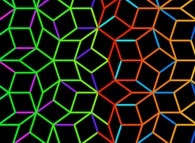
Golden Triangles and Plane non Periodical Penrose Tilings.
----------
Golden Triangles and Plane non Periodical Penrose Tilings. | 
Some questions regarding the Hugh Everett's Multiverse.
----------
Some questions regarding the Hugh Everett's Multiverse. | 
Generative Artificial Intelligences and Pictures Synthesis: The Museum of Babel, The Virtual Museum of the 21th Century (A Tribute to a Universal Artist?).
----------
Generative Artificial Intelligences and Pictures Synthesis: The Museum of Babel, The Virtual Museum of the 21th Century (A Tribute to a Universal Artist?). | 
La Fractale Ultime: un Hommage à Benoît Mandelbrot (1924-2010). |
Images du Virtuel (La renaissance de la pensée visuelle dans l'univers de la recherche scientifique). | 
Synthesis of Impossible Structures.
----------
Synthesis of Impossible Structures. | 
On the Irreversibility of Digital Time.
----------
On the Irreversibility of Digital Time. | 
Synthesis of Labyrinths.
----------
Synthesis of Labyrinths. |
Quelques souvenirs personnels à l'occasion du cinquantenaire du CMAP (1974-2014). | 
Hilbert Curves and Infinite Knots.
----------
Hilbert Curves and Infinite Knots. | 
Are we alone in the Universe? The Fermi Paradox: Definition, some Solutions,....
----------
Are we alone in the Universe? The Fermi Paradox: Definition, some Solutions,.... | 
Les Apprentis-Dieux (Tout est Information). |
Space filling Curves and Beyond: From Squares and Cubes to Surfaces (bidimensional Manifolds) and tridimensional Manifolds.
----------
Space filling Curves and Beyond: From Squares and Cubes to Surfaces (bidimensional Manifolds) and tridimensional Manifolds. | 
Transcendental Numbers.
----------
Transcendental Numbers. | 
A Quoi Servent (et Que Sont) les Mathématiques? Où sont les Mathématiques? Les Mathématiques, de la vie courante à la recherche fondamentale. Les Mathématiques, une fenêtre ouverte sur l'Univers et au-delà. |
The staging of numbers.
----------
The staging of numbers. |
From Monodimensional Binary Cellular Automata to Monodimensional "Quasi-Continuous" Cellular Automata, (Random) Perturbations of Cellular Automata.
----------
From Monodimensional Binary Cellular Automata to Monodimensional "Quasi-Continuous" Cellular Automata, (Random) Perturbations of Cellular Automata. | 
The Brownian Motion.
----------
The Brownian Motion. | 
Mouvements Relatifs et Observations Astronomiques (le géocentrisme revisité). | 
Universe, Multiverse and Simulation (A few remarks regarding the Multiverse).
----------
Universe, Multiverse and Simulation (A few remarks regarding the Multiverse). |
N-Dimensional Deterministic Fractal Sets using Quaternions, Octonions and more (MandelBulb, JuliaBulbs and beyond...).
----------
N-Dimensional Deterministic Fractal Sets using Quaternions, Octonions and more (MandelBulb, JuliaBulbs and beyond...). | 
Quelques Remarques concernant la Nature des Mathématiques. | 
Les Nombres et la Lumière. | 
Is a Computer a Perfect Computing Machine?.
----------
Is a Computer a Perfect Computing Machine?. |
De la Perte de l'Associativité et de la Distributivité ou Les Nombres Flottants ne sont pas des Rationnels et encore moins des Réels. | 
Perte de l'Associativité de l'Addition. |
Perte de l'Associativité de la Multiplication. | 
About the Countability of the Algebraic Numbers (Polynomials with integer coefficients, Prime Numbers, Rational Numbers and Transcendent Numbers).
----------
About the Countability of the Algebraic Numbers (Polynomials with integer coefficients, Prime Numbers, Rational Numbers and Transcendent Numbers). |
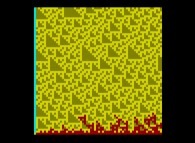
Proth-Gilbreath Conjecture, Verification up to 1.5x10^15.
----------
Proth-Gilbreath Conjecture, Verification up to 1.5x10^15. |
Quelques Questions et Remarques sur la Recherche, les Chercheurs et les Ingénieurs. | 
Ockham's razor and Mathematics.
----------
Ockham's razor and Mathematics. | 
Why do we Need Real Numbers?.
----------
Why do we Need Real Numbers?. |
Quelques Remarques sur le Cerveau. | 
Visualizing with Spheres. | 
Stéréogrammes et Autostéréogrammes. | 
Definition and Animation of Bi- and Tridimensional Manifolds by Means of Pseudo-Projections, Picture Self-Transformations.
----------
Definition and Animation of Bi- and Tridimensional Manifolds by Means of Pseudo-Projections, Picture Self-Transformations. |
The Ulam Spiral and its generalizations.
----------
The Ulam Spiral and its generalizations. | 
Virtual (or Subjective) Chaos.
----------
Virtual (or Subjective) Chaos. | 
About Real Number Visualization.
----------
About Real Number Visualization. | 
Tridimensional Dispaly. |
Welcome to Mars (1.000.000 settlers on Mars whitin a quarter century: the stupidest idea on Earth?).
----------
Welcome to Mars (1.000.000 settlers on Mars whitin a quarter century: the stupidest idea on Earth?). | 
Creativity and Simplicity. |
Un Environnement Portable de Programmation et de Coopération sur Réseau Hétérogène pour le Calcul Scientifique, l'Analyse Visuelle des Résultats et les Tests de Sensibilité à la Précision des Calculs. | 
Of the Center of the Solar System. |
|
Les Mathématiques:
Pour beaucoup d'entre-nous et en particulier parmi les jeunes, les Mathématiques ne servent à rien et sont absentes de la vie courante.
Si elles sont ainsi perçues trois acteurs au moins en sont responsables:
- D'une part les enseignants de toutes les disciplines (et plus particulièrement scientifiques)
ne font peut-être pas l'effort nécessaire, mais en ont-ils les moyens?
- D'autre part les gouvernants qui fixent les grandes lignes des politiques éducatives.
- Enfin, les Mathématiques elles-mêmes. En effet, il est bien difficile de voir l'intérêt des recherches portant sur:
|
Et pourtant, une simple histoire peut rendre cet intérêt évident.
Ainsi, la Géométrie (dite euclidienne),
que l'on enseigne dès le primaire avec ses triangles, ses carrés,... repose sur quelques axiomes.
L'un d'entre-eux, l' axiome des parallèles fut en réalité pendant deux millénaires
une conjecture que nombreux furent ceux qui tentèrent d'en faire
un théorème, mais en vain. Au milieu du XIXe siècle,
il fallu se rendre à l'évidence: ce ne pouvait qu'être un axiome (donc
indémontrable).
Plusieurs grands mathématiciens tels Carl Friedrich Gauss, Nikolai Ivanovich Lobachevsky, Bernhard Riemann,...
imaginèrent alors de nouvelles géométries en "jouant" sur cet axiome.
Ainsi les physiciens, en particulier ceux qui étudient l'Univers,
eurent alors entre leurs mains de nouveaux outils: à eux de savoir lesquels étaient alors utiles.
Et c'est ainsi qu'en 1915, Albert Einstein publia un nouvel article révolutionnaire,
"La Relativité Générale" dans lequel il montrait que l'espace-temps
(à quatre dimensions) n'était pas euclidien: c'était une variété dite riemannienne
dont la courbure conditionne les trajectoires des masses/énergies qui elles-mêmes provoquent cette courbure:
Très rapidement de nombreux physiciens s'en emparèrent et
en particulier Georges Lemaître qui se rendit compte alors que, malgré la croyance d'Albert Einstein, l'Univers ne pouvait
pas être statique. En 1929, les observations d'Edwin Hubble (en collaboration avec Milton Humason)
et Vesto Melvin Slipher montrèrent que les autres galaxies
semblaient s'éloigner de nous, la Voie Lactée, d'autant plus vite qu'elles étaient plus lointaines,
ce qui se voit par une analyse spectroscopique de leur lumière qui met alors en évidence un décalage vers le rouge des fréquences.
L'Univers n'était donc pas statique, mais en expansion
et si l'on regarde "le film à l'envers", il doit donc montrer une contraction vers une "singularité" (de dimension nulle et de densité
infinie, dans le cadre de la Relativité Générale en ignorant la Mécanique Quantique...).
Cette singularité fut surnommée "Big Bang" par Fred Hoyle dans les années 1950
pour dénigrer cette théorie préférant la sienne dite de l'état stationnaire, mais il dont il fut prouvé par la suite
qu'elle n'était pas compatible avec les observations et les mesures.
La Relativité Générale permet donc de décrire l'Univers dans son intégralité:
mais aussi des phénomènes
difficiles à appréhender tellement ils sont "cataclysmiques" comme les trous noirs ou les ondes gravitationnelles:

On notera qu'Albert Einstein avait annoncé la possible existence de ces ondes, en ajoutant que probablement
on ne les détecterait jamais. Et de fait, il fallut attendre un siècle pour que les deux interféromètres LIGO aux USA
(états de Washington et de Louisiane) "voient"
les premières le 14/09/2015. Pour moi, il s'agit là du plus bel exemple d'une découverte faite grace aux Mathématiques,
alors que, sans ces dernières, ces ondes n'auraient pu êtres détectées par hasard, contrairement
à l'expansion de l'Univers qui l'aurait été, "simplement"
en observant le décalage vers le rouge de la lumière des galaxies lointaines et ce même si Georges Lemaître ne l'avait pas mise en
évidence là encore grace à la Relativité Générale...
|
Dans notre quotidien, la Relativité Générale semble bien inutile et éloignée de nos préoccupations quotidiennes...
Mais cela est complétement faux et ignoré du grand public! Ainsi, le GPS,
omniprésent dans la vie courante, fait reposer les nécessaires mesures spatiales sur des mesures de durées, or le temps et l'espace sont intimement liés.
Sans la prise en compte de la Relativité Générale (et de la Relativité Restreinte...), le GPS n'aurait que peu d'utilité!
Les mathématiques sont partout dans la vie courante, mais aussi évidemment dans l'industrie et dans la recherche la plus fondamentale:
sans elles, par exemple, pas de Mécanique Quantique et donc pas de circuits intégrés et encore moins d'ordinateurs et de téléphones portables.
On ne peut échapper au sentiment que ces formules mathématiques ont une existence qui leur est propre, qu'elles sont plus savantes que
ceux qui les ont découvertes, et que nous pouvons en extraire plus de science qu'il n'en a été mis à l'origine.
(Heinrich Hertz, XIXe siècle).
Mais pourquoi en est-il ainsi?
Pourquoi cette "redoutable efficacité" (Eugène Wigner, Prix Nobel de Physique en 1963)?
Et que sont les Mathématiques? En fait, plusieurs points de vue sont possibles:
- Elles sont un jeu de l'esprit ainsi que le montre les conjectures:
![Tridimensional display of the Riemann Zeta function inside [-10.0,+60.0]x[-35.0,+35.0] (bird's-eye view)](../images/ZETA.12.m.D/timbre.jpg "Tridimensional display of the Riemann Zeta function inside [-10.0,+60.0]x[-35.0,+35.0] (bird's-eye view)")
- Elles offrent un ensemble illimité d'analogies:
- Elles compriment les mesures et font émerger de nouvelles lois:
- Elles sont LE langage de l'Univers (Galilée, XVI-XVIIe siècles)
- Elles sont un instrument virtuel d'optique, tout à la fois microscope et téléscope, ouvrant la voie à des
voyages et des découvertes autrement inimaginables:

- Un peu tout cela à la fois?
- Et si les Mathématiques étaient L'Ultime et Unique Réalité?
Et le mathématicien est-il alors un inventeur ou un explorateur?
Peut-être les deux à la fois: "Dieu a fait les nombres entiers, tout le reste est l'œuvre de l'homme" (Leopold Kronecker, 1891).
Le saurons-nous jamais?
L'INFORMATIQUE:
Les grands pionniers du calcul et de son automatisation furent aussi, pour la plupart, des mathématiciens:
- John Neper
( logarithms and the slide rule,
1550-1617),
- Blaise Pascal
(the adding machine -la pascaline-,
1623-1662),
- Gottfried Wilhelm Leibniz
(the multiplying machine,
1646-1716),
- Jacques Vaucanson
(the automatons,
1709-1782),
- Joseph Marie Jacquard
(the loom, a precursor to programmable machines
-first perforated supports: cards et ribbons-,
1752-1834),
- Charles Babbage
(the first computer -mechanical-,
1791-1871),
- Lady Ada Lovelace
(the firts programmer in history on Charles Babbage's machine,
1815-1852),
- George Boole
(the binary algebra {0,1},
1815-1864),
- John von Neumann
(the von Neumann architecture,
1903-1957),
- Alan Turing
(computability, universal Turing machine ,
1912-1954),
- etc...
|
Aujourd'hui les liens entre Mathématiques et Informatique sont de plus en plus entrelacés. Cela se voit, par exemple,
avec les vérificateurs de preuve ou encore l'Intelligence Artificielle:
ou encore évidemment le calcul.
En effet, disposer des équations et des formules décrivant un certain système (industriel ou scientifique)
ne suffit pas à l'ingénieur ou au chercheur. Il leur faut des prédictions et cela passe évidemment par des calculs.
Il est loin le temps où Urbain Le Verrier, armé d'un seul crayon, avait calculé pendant des mois la
position de l'hypothétique planète Neptune. Il est loin aussi le temps
des débuts des recherches ici relatées équipé d'un ordinateur doté d'une mémoire
de seulement 32 Ko (!) et de deux disques de chacun 512 Ko (!):
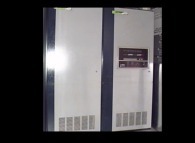
Après quelques années avec un langage d'assemblage
pour seul moyen d'expression (et ce à cause des limitations physiques de cet ordinateur),
avec l'arrivée de systèmes UNIX puis Linux s'est immédiatement posé le problème de la portabilité
résolu alors par le développement d'un environnement de programmation complet utilisé sans discontinuité depuis.
Trois objectifs principaux étaient ainsi satisfaits:
L'ART:
Il a toujours été évident
que sur certaines images purement scientifiques un autre regard pouvait être porté, comme l'illustre très nettement
la Géométrie Fractale de Benoît Mandelbrot:
et que les outils ainsi développés pouvaient être détournés à des fins purement artistiques et alors, par exemple,
rendre un hommage "mathématique" à quelques artistes du XXe siècle:
|