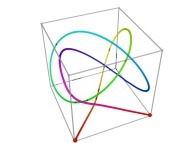
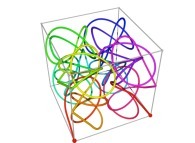
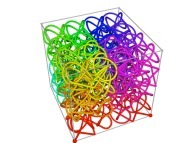
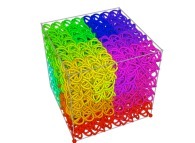
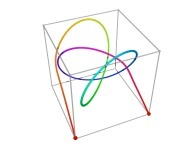
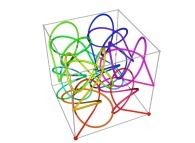
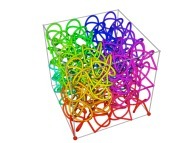
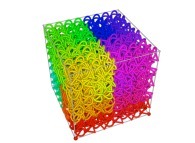
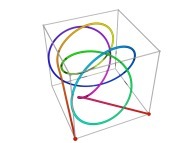
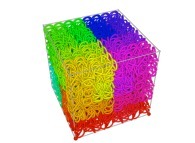
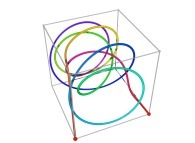
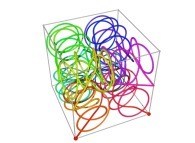
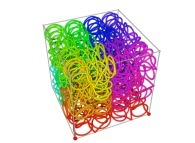
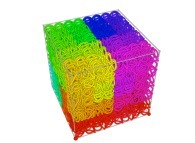
A Tridimensional Hilbert-like Curve defined with {X1(...),Y1(...),Z1(...)} -iteration 1- [Une courbe tridimensionnelle du type Hilbert définie avec {X1(...),Y1(...),Z1(...)} -itération 1- ]

A Tridimensional Hilbert-like Curve defined with {X1(...),Y1(...),Z1(...)} -iteration 1- [Une courbe tridimensionnelle du type Hilbert définie avec {X1(...),Y1(...),Z1(...)} -itération 1-].
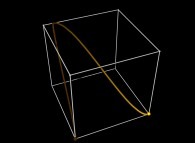


The tridimensional Hilbert Curves:

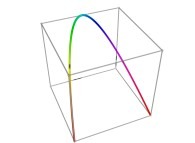
Let's C1(T) being a parametric curve A Tridimensional Hilbert-like Curve defined with {X1(...),Y1(...),Z1(...)} -iteration 1- defined by means of 3 real functions of T (T [0,1]) X1(T) [0,1], Y1(T) [0,1] and Z1(T) [0,1] such as :
                    X1(T=0)=0 Y1(T=0)=0 Z1(T=0)=0 (lower left foreground corner)
                    X1(T=1)=1 Y1(T=1)=0 Z1(T=1)=0 (lower right foreground corner)


Then one defines a sequence of curves Ci(T) (i >= 1) as follows :
                    Ci(T) = {Xi(T),Yi(T),Zi(T)}  [0,1]x[0,1]x[0,1] --> Ci+1(T) = {Xi+1(T),Yi+1(T),Zi+1(T)}  [0,1]x[0,1]x[0,1]

                    if T  [0,1/8[:
                              Xi+1(T) =   Xi(8T-0)
                              Yi+1(T) =   Zi(8T-0)
                              Zi+1(T) =   Yi(8T-0)
                                                   Transformation 1
                    if T  [1/8,2/8[:
                              Xi+1(T) =   Zi(8T-1)
                              Yi+1(T) = 1+Yi(8T-1)
                              Zi+1(T) =   Xi(8T-1)
                                                   Transformation 2
                    if T  [2/8,3/8[:
                              Xi+1(T) = 1+Xi(8T-2)
                              Yi+1(T) = 1+Yi(8T-2)
                              Zi+1(T) =   Zi(8T-2)
                                                   Transformation 3
                    if T  [3/8,4/8[:
                              Xi+1(T) = 1+Zi(8T-3)
                              Yi+1(T) = 1-Xi(8T-3)
                              Zi+1(T) = 1-Yi(8T-3)
                                                   Transformation 4
                    if T  [4/8,5/8[:
                              Xi+1(T) = 2-Zi(8T-4)
                              Yi+1(T) = 1-Xi(8T-4)
                              Zi+1(T) = 1+Yi(8T-4)
                                                   Transformation 5
                    if T  [5/8,6/8[:
                              Xi+1(T) = 1+Xi(8T-5)
                              Yi+1(T) = 1+Yi(8T-5)
                              Zi+1(T) = 1+Zi(8T-5)
                                                   Transformation 6
                    if T  [6/8,7/8[:
                              Xi+1(T) = 1-Zi(8T-6)
                              Yi+1(T) = 1+Yi(8T-6)
                              Zi+1(T) = 2-Xi(8T-6)
                                                   Transformation 7
                    if T  [7/8,1]:
                              Xi+1(T) =   Xi(8T-7)
                              Yi+1(T) = 1-Zi(8T-7)
                              Zi+1(T) = 2-Yi(8T-7)
                                                   Transformation 8
Please note that 8=2d where d=3 is the space dimension.


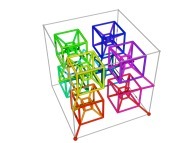
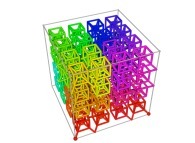
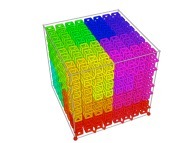
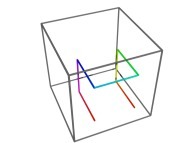
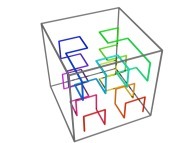
Here are the four first tridimensional Hilbert curves with an increasing number of iterations :

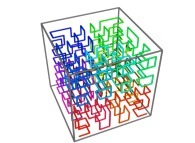
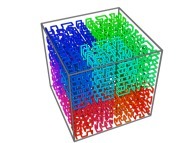
Tridimensional Hilbert Curve -iteration 1- Tridimensional Hilbert Curve -iteration 2- Tridimensional Hilbert Curve -iteration 3- Tridimensional Hilbert Curve -iteration 4- [See the used color set to display the parameter T]

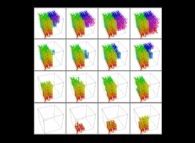
See the construction of one of them :

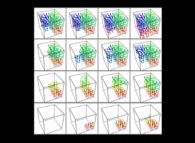
Empty Empty The construction of the tridimensional Hilbert Curve -iteration 3- Empty


Here are some examples of Hilbert-like tridimensional curves using different generating curves and in particular "open" knots :

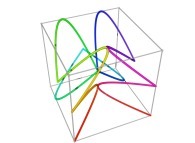
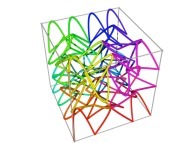
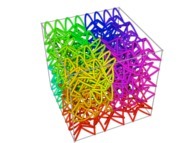
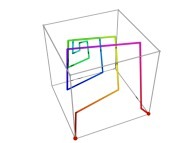
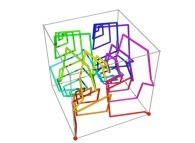
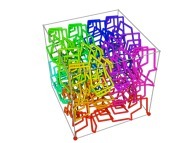
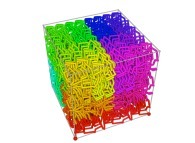
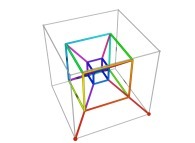
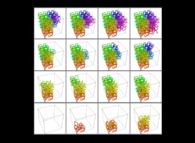
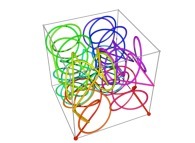
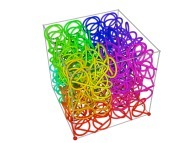
A Tridimensional Hilbert-like Curve defined with {X1(...),Y1(...),Z1(...)} -iteration 1- A Tridimensional Hilbert-like Curve defined with {X2(...),Y2(...),Z2(...)} -iteration 2- A Tridimensional Hilbert-like Curve defined with {X3(...),Y3(...),Z3(...)} -iteration 3- A Tridimensional Hilbert-like Curve defined with {X4(...),Y4(...),Z4(...)} -iteration 4-
Empty Empty The construction of a tridimensional Hilbert-like Curve defined with {X3(...),Y3(...),Z3(...)} and based on an 'open' 3-foil torus knot -iteration 3- Empty
A Tridimensional Hilbert-like Curve defined with {X1(...),Y1(...),Z1(...)} and based on an 'open' 3-foil torus knot -iteration 1- A Tridimensional Hilbert-like Curve defined with {X2(...),Y2(...),Z2(...)} and based on an 'open' 3-foil torus knot -iteration 2- A Tridimensional Hilbert-like Curve defined with {X3(...),Y3(...),Z3(...)} and based on an 'open' 3-foil torus knot -iteration 3- A Tridimensional Hilbert-like Curve defined with {X4(...),Y4(...),Z4(...)} and based on an 'open' 3-foil torus knot -iteration 4-
Empty Empty The construction of a tridimensional Hilbert-like Curve defined with {X3(...),Y3(...),Z3(...)} and based on an 'open' 3-foil torus knot -iteration 3- Empty
A Tridimensional Hilbert-like Curve defined with {X1(...),Y1(...),Z1(...)} and based on an 'open' 5-foil torus knot -iteration 1- A Tridimensional Hilbert-like Curve defined with {X2(...),Y2(...),Z2(...)} and based on an 'open' 5-foil torus knot -iteration 2- A Tridimensional Hilbert-like Curve defined with {X3(...),Y3(...),Z3(...)} and based on an 'open' 5-foil torus knot -iteration 3- A Tridimensional Hilbert-like Curve defined with {X4(...),Y4(...),Z4(...)} and based on an 'open' 5-foil torus knot -iteration 4-
A Tridimensional Hilbert-like Curve defined with {X1(...),Y1(...),Z1(...)} and based on an 'open' 7-foil torus knot -iteration 1- A Tridimensional Hilbert-like Curve defined with {X2(...),Y2(...),Z2(...)} and based on an 'open' 7-foil torus knot -iteration 2- A Tridimensional Hilbert-like Curve defined with {X3(...),Y3(...),Z3(...)} and based on an 'open' 7-foil torus knot -iteration 3- A Tridimensional Hilbert-like Curve defined with {X4(...),Y4(...),Z4(...)} and based on an 'open' 7-foil torus knot -iteration 4-

[More information about Peano Curves and Infinite Knots -in english/en anglais-]
[Plus d'informations à propos des Courbes de Peano et des Nœuds Infinis -en français/in french-]


(CMAP28 WWW site: this page was created on 05/21/2022 and last updated on 06/04/2026 23:20:58 -CEST-)


[See the generator of this picture [Voir le générateur de cette image]]

[See all related pictures (including this one) [Voir toutes les images associées (incluant celle-ci)]]


[Go back toMathematics - A Virtual Instrument For Exploring Space Time And Beyond [Retour à {a chapter of 'Mathematics-AVirtualInstrumentForExploringSpaceTimeAndBeyond'}]]

[The Y2K Bug [Le bug de l'an 2000]]
[Are we ready for the Year 2038 [Notre informatique est-elle prête pour l'An 2038]?]

[Site Map and Help [Plan du Site et Aide]]
[Mail [Courrier]]
[About Pictures and Animations [A Propos des Images et des Animations]]


Copyright © Jean-François COLONNA, 2022-2026.
Copyright © CMAP (Centre de Mathématiques APpliquées) UMR CNRS 7641 / École polytechnique, Institut Polytechnique de Paris, 2022-2026.