Space filling Curves and Beyond:
From Squares and Cubes to Surfaces (bidimensional Manifolds) and tridimensional Manifolds


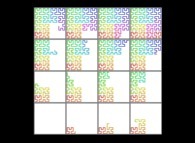
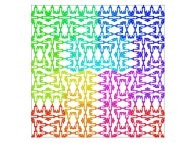
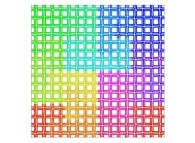
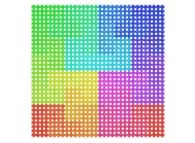
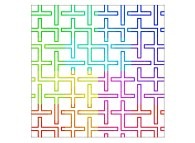
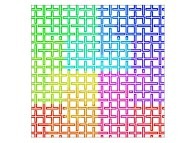
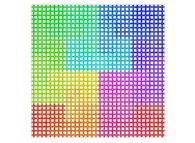
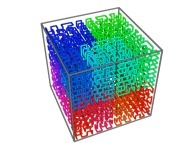
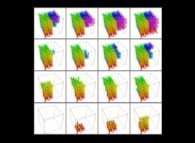
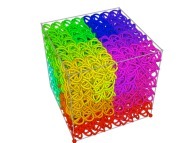
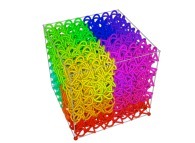
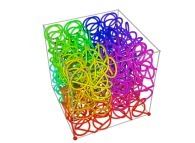
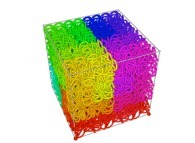
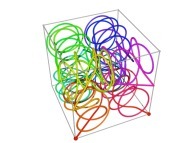
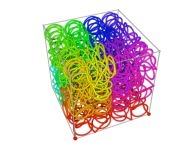
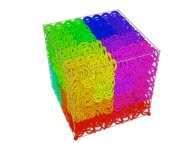
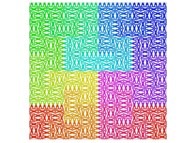
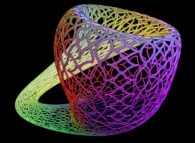
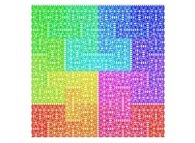
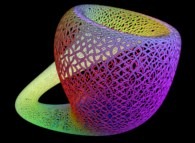
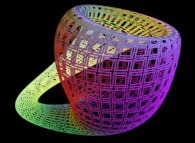
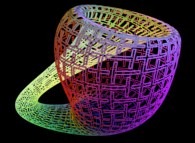
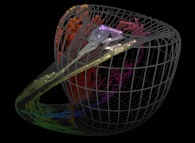
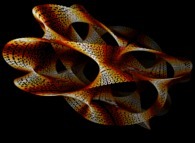
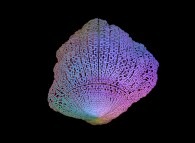
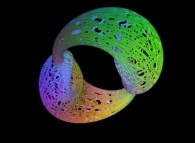
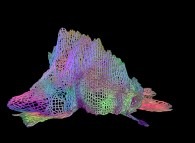
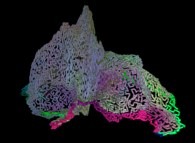
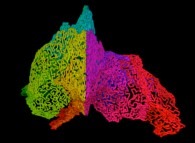
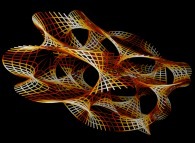
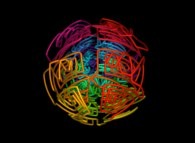
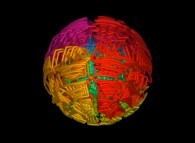
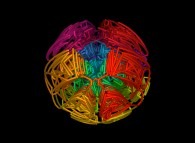
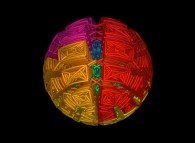
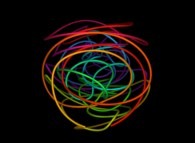
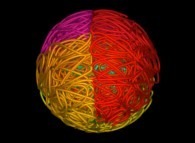
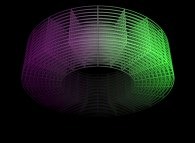
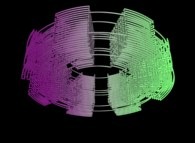
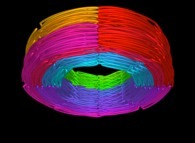
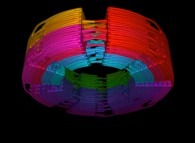
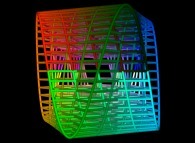
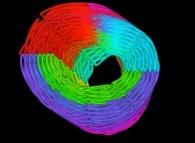
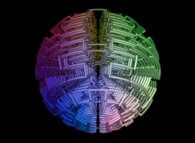
Tridimensional representation of a quadridimensional Calabi-Yau manifold described by means of 5x5 Bidimensional Hilbert Curves -iteration 5-

Jean-François COLONNA
[Contact me]

www.lactamme.polytechnique.fr

CMAP (Centre de Mathématiques APpliquées) UMR CNRS 7641, École polytechnique, Institut Polytechnique de Paris, CNRS, France

[Site Map and Help [Plan du Site et Aide]]
[The Y2K Bug [Le bug de l'an 2000]]
[Are we ready for the Year 2038 [Notre informatique est-elle prête pour l'An 2038]?]
[Real Numbers don't exist in Computers and Floating Point Computations aren't safe. [Les Nombres Réels n'existent pas dans les Ordinateurs et les Calculs Flottants ne sont pas sûrs.]]
[Please, visit A Virtual Machine for Exploring Space-Time and Beyond, the place where you can find more than 10.000 pictures and animations between Art and Science]
(CMAP28 WWW site: this page was created on 04/17/2023 and last updated on 05/09/2026 10:58:21 -CEST-)


[en français/in french]


Contents:


1-Georg Cantor:

In the second half of the nineteenth century, Georg Cantor was one of the founders of set theory by questioning the concept of infinity. Using the notion of the power set (ie. the set of all subsets of a given set), he showed that there was not one infinity, but an infinity of infinities. The smallest infinity is that of the integers N: the countable infinity. The notion of bijection between two sets is then fundamental: two sets have the same cardinality ("are the same size") if there exists a bijection between them. It is almost paradoxical that sets such as the even numbers, the rationals, the algebraic numbers, etc. are in bijection with N and are therefore countable. However, using a proof by contradiction of astonishing simplicity, Cantor showed that this was not the case with the set of real numbers R: R is not countable. Note that knowing whether there are sets of intermediate size between N and R is (unfortunately...) an undecidable (the so-called Continuum Hypothesis) of ZFC (Zermelo, Fraenkel and axiom of Choice) set theory. Beyond R, there are therefore an infinity of increasingly enormous sets obtained, for example, by iterating the definition P of the power set: {E,P(E),P(P(E)),...}. But despite this, Georg Cantor showed that R, R2,... Rn,... had the same cardinality.


2-David Hilbert, Giuseppe Peano and more:

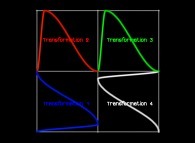
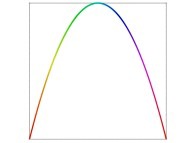
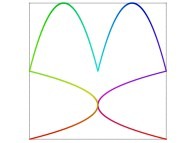
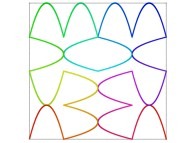
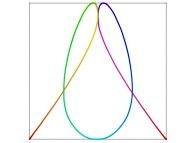
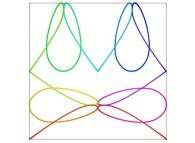
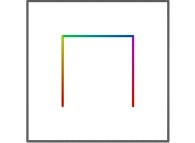
Building on this result, David Hilbert, Giuseppe Peano, and others imagined curves (parameterized in R) filling a square (in R2). One simple way to proceed is to start with a so-called generating curve Bidimensional Hilbert Curve -iteration 1- that will be reduced and transformed by repeating the process an infinite number of times. To illustrate this process, here is a specific generating curve A Bidimensional Hilbert-like Curve defined with {X1(...),Y1(...)} -iteration 1- and the four transformations A Bidimensional Hilbert-like Curve defined with {X2(...),Y2(...)} -iteration 2- it must undergo at each iteration.
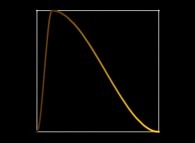

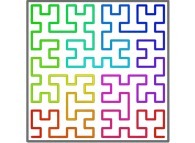
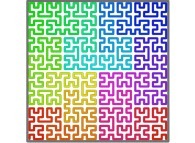
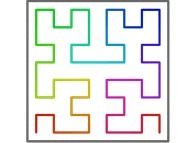
Here are the five first bidimensional Hilbert curves with an increasing number of iterations :
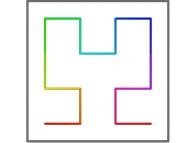
Bidimensional Hilbert Curve -iteration 1- Bidimensional Hilbert Curve -iteration 2- Bidimensional Hilbert Curve -iteration 3- Bidimensional Hilbert Curve -iteration 4- Bidimensional Hilbert Curve -iteration 5-

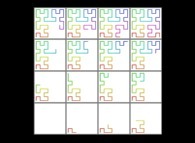
See the construction of some of them :

Empty Empty The construction of the bidimensional Hilbert Curve -iteration 3- The construction of the bidimensional Hilbert Curve -iteration 4- Empty


Here are some examples of Hilbert-like bidimensional curves using different generating curves :

A Bidimensional Hilbert-like Curve defined with {X1(...),Y1(...)} -iteration 1- A Bidimensional Hilbert-like Curve defined with {X2(...),Y2(...)} -iteration 2- A Bidimensional Hilbert-like Curve defined with {X3(...),Y3(...)} -iteration 3- A Bidimensional Hilbert-like Curve defined with {X4(...),Y4(...)} -iteration 4- A Bidimensional Hilbert-like Curve defined with {X5(...),Y5(...)} -iteration 5-
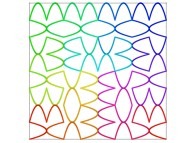
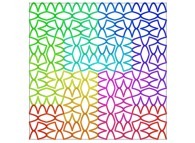
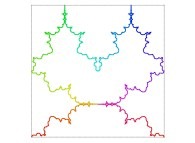
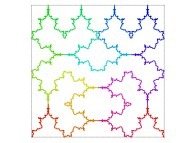
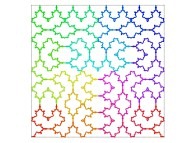
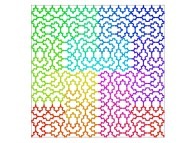
A Bidimensional Hilbert-like Curve defined with {X1(...),Y1(...)} related to the Mandelbrot set border -iteration 1- A Bidimensional Hilbert-like Curve defined with {X1(...),Y1(...)} related to the Mandelbrot set border -iteration 2- A Bidimensional Hilbert-like Curve defined with {X1(...),Y1(...)} related to the Mandelbrot set border -iteration 3- A Bidimensional Hilbert-like Curve defined with {X1(...),Y1(...)} related to the Mandelbrot set border -iteration 4- A Bidimensional Hilbert-like Curve defined with {X1(...),Y1(...)} related to the Mandelbrot set border -iteration 5-
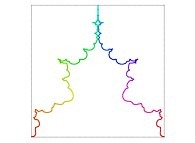
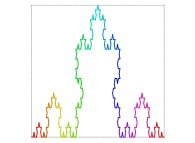
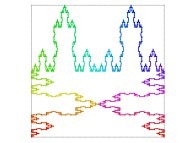
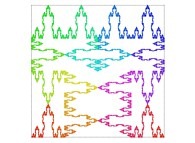
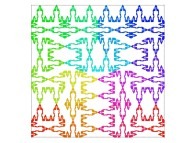
A Bidimensional Hilbert-like Curve defined with {X1(...),Y1(...)} related to the von Koch Curve -iteration 1- A Bidimensional Hilbert-like Curve defined with {X1(...),Y1(...)} related to the von Koch Curve -iteration 2- A Bidimensional Hilbert-like Curve defined with {X1(...),Y1(...)} related to the von Koch Curve -iteration 3- A Bidimensional Hilbert-like Curve defined with {X1(...),Y1(...)} related to the von Koch Curve -iteration 4- A Bidimensional Hilbert-like Curve defined with {X1(...),Y1(...)} related to the von Koch Curve -iteration 5-
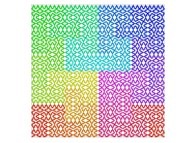
A Bidimensional Hilbert-like Curve defined with {X1(...),Y1(...)} related to a periodical impossible structure -iteration 1- A Bidimensional Hilbert-like Curve defined with {X1(...),Y1(...)} related to a periodical impossible structure -iteration 2- A Bidimensional Hilbert-like Curve defined with {X1(...),Y1(...)} related to a periodical impossible structure -iteration 3- A Bidimensional Hilbert-like Curve defined with {X1(...),Y1(...)} related to a periodical impossible structure -iteration 4- A Bidimensional Hilbert-like Curve defined with {X1(...),Y1(...)} related to a periodical impossible structure -iteration 5-
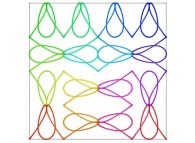
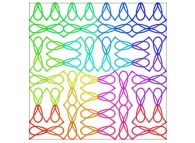
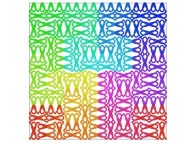
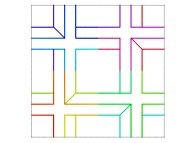
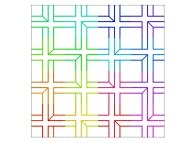
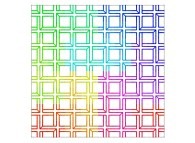
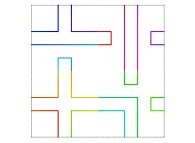
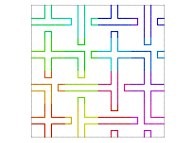
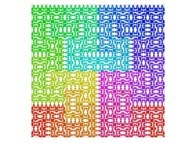
A Bidimensional non continous Hilbert-like Curve defined with {X1(...),Y1(...)} related to a periodical 'labyrinthic' structure -iteration 1- A Bidimensional non continous Hilbert-like Curve defined with {X1(...),Y1(...)} related to a periodical 'labyrinthic' structure -iteration 2- A Bidimensional non continous Hilbert-like Curve defined with {X1(...),Y1(...)} related to a periodical 'labyrinthic' structure -iteration 3- A Bidimensional non continous Hilbert-like Curve defined with {X1(...),Y1(...)} related to a periodical 'labyrinthic' structure -iteration 4- A Bidimensional non continous Hilbert-like Curve defined with {X1(...),Y1(...)} related to a periodical 'labyrinthic' structure -iteration 5-


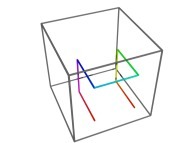
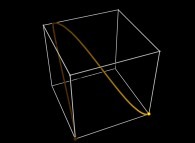
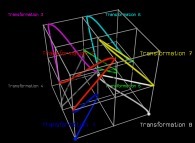
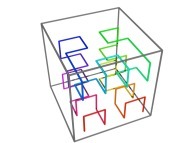
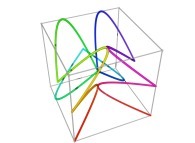
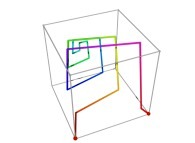
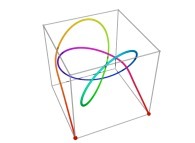
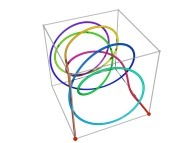
This process can be generalized, and it is thus possible to fill a cube (in R3) using curves (still parameterized in R). Here is one of the generating curves Tridimensional Hilbert Curve -iteration 1- , and again, a specific generating curve A Tridimensional Hilbert-like Curve defined with {X1(...),Y1(...),Z1(...)} -iteration 1- allows us to understand the eight transformations A Tridimensional Hilbert-like Curve defined with {X2(...),Y2(...),Z2(...)} -iteration 2- it undergoes at each iteration.


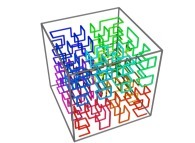
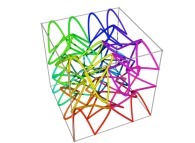
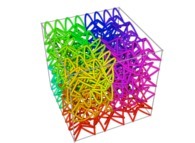
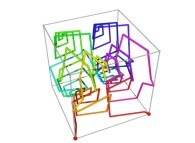
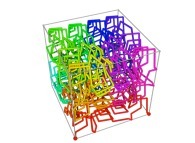
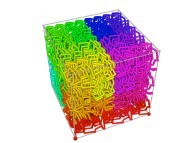
Here are the four first tridimensional Hilbert curves with an increasing number of iterations :
Tridimensional Hilbert Curve -iteration 1- Tridimensional Hilbert Curve -iteration 2- Tridimensional Hilbert Curve -iteration 3- Tridimensional Hilbert Curve -iteration 4-

See the construction of one of them :
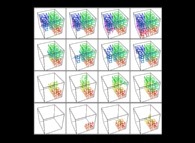
Empty Empty The construction of the tridimensional Hilbert Curve -iteration 3- Empty


Here are some examples of Hilbert-like tridimensional curves using different generating curves and in particular "open" knots :
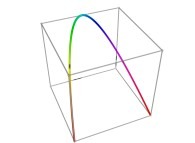
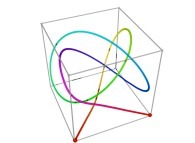
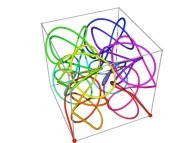
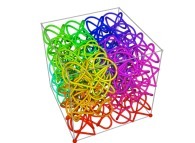
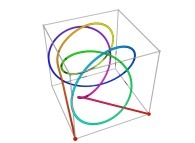
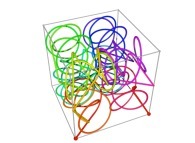
A Tridimensional Hilbert-like Curve defined with {X1(...),Y1(...),Z1(...)} -iteration 1- A Tridimensional Hilbert-like Curve defined with {X2(...),Y2(...),Z2(...)} -iteration 2- A Tridimensional Hilbert-like Curve defined with {X3(...),Y3(...),Z3(...)} -iteration 3- A Tridimensional Hilbert-like Curve defined with {X4(...),Y4(...),Z4(...)} -iteration 4-
Empty Empty The construction of a tridimensional Hilbert-like Curve defined with {X3(...),Y3(...),Z3(...)} and based on an 'open' 3-foil torus knot -iteration 3- Empty
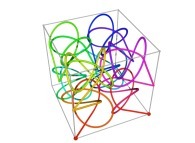
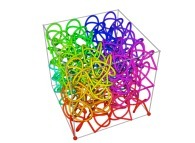
A Tridimensional Hilbert-like Curve defined with {X1(...),Y1(...),Z1(...)} and based on an 'open' 3-foil torus knot -iteration 1- A Tridimensional Hilbert-like Curve defined with {X2(...),Y2(...),Z2(...)} and based on an 'open' 3-foil torus knot -iteration 2- A Tridimensional Hilbert-like Curve defined with {X3(...),Y3(...),Z3(...)} and based on an 'open' 3-foil torus knot -iteration 3- A Tridimensional Hilbert-like Curve defined with {X4(...),Y4(...),Z4(...)} and based on an 'open' 3-foil torus knot -iteration 4-
Empty Empty The construction of a tridimensional Hilbert-like Curve defined with {X3(...),Y3(...),Z3(...)} and based on an 'open' 3-foil torus knot -iteration 3- Empty
A Tridimensional Hilbert-like Curve defined with {X1(...),Y1(...),Z1(...)} and based on an 'open' 5-foil torus knot -iteration 1- A Tridimensional Hilbert-like Curve defined with {X2(...),Y2(...),Z2(...)} and based on an 'open' 5-foil torus knot -iteration 2- A Tridimensional Hilbert-like Curve defined with {X3(...),Y3(...),Z3(...)} and based on an 'open' 5-foil torus knot -iteration 3- A Tridimensional Hilbert-like Curve defined with {X4(...),Y4(...),Z4(...)} and based on an 'open' 5-foil torus knot -iteration 4-
A Tridimensional Hilbert-like Curve defined with {X1(...),Y1(...),Z1(...)} and based on an 'open' 7-foil torus knot -iteration 1- A Tridimensional Hilbert-like Curve defined with {X2(...),Y2(...),Z2(...)} and based on an 'open' 7-foil torus knot -iteration 2- A Tridimensional Hilbert-like Curve defined with {X3(...),Y3(...),Z3(...)} and based on an 'open' 7-foil torus knot -iteration 3- A Tridimensional Hilbert-like Curve defined with {X4(...),Y4(...),Z4(...)} and based on an 'open' 7-foil torus knot -iteration 4-


3-Tridimensional Surfaces (Bidimensional Manifolds):

Many surfaces -bidimensional manifolds- in a tridimensional space can be defined using a set of three equations:
                    X = Fx(u,v)
                    Y = Fy(u,v)
                    Z = Fz(u,v)
with:
                    u  [Umin,Umax]
                    v  [Vmin,Vmax]
For example:
                    Fx(u,v) = R.sin(u).cos(v)
                    Fy(u,v) = R.sin(u).sin(v)
                    Fz(u,v) = R.cos(u)
with:
                     u  [0,pi]
                     v  [0,2.pi]
defines a sphere with R as the radius and the origin of the coordinates as the center.


[Umin,Umax]*[Vmin,Vmax] then defined a bidimensional rectangular domain D.
                       v ^
                         |
                    V    |...... ---------------------------
                     max |      |+++++++++++++++++++++++++++|
                         |      |+++++++++++++++++++++++++++|
                         |      |+++++++++++++++++++++++++++|
                         |      |+++++++++++++++++++++++++++|
                         |      |+++++++++++++++++++++++++++|
                         |      |+++++++++++++++++++++++++++|
                         |      |+++++++++++++++++++++++++++|
                         |      |+++++++++++++++++++++++++++|
                         |      |+++++++++++++++++++++++++++|
                    V    |...... ---------------------------
                     min |      :                           :
                         |      :                           :
                         O------------------------------------------------->
                                U                           U              u
                                 min                         max


Let's define a curve that fills the [0,1]x[0,1] square :
                         ^
                         |
                       1 |---------------
                         | +++++   +++++ |
                         | +   +   +   + |
                         | +   +++++   + |
                         | +           + |
                         | +++++   +++++ |
                         |     +   +     |
                         | +++++   +++++ |
                       0 O------------------------>
                         0               1


Obviously one can define a mapping between the [0,1]x[0,1] square and the [Umin,Umax]*[Vmin,Vmax] domain :
                       v ^
                         |
                    V    |...... ---------------------------
                     max |      | ++++++++         ++++++++ |
                         |      | +      +         +      + |
                         |      | +      +         +      + |
                         |      | +      +++++++++++      + |
                         |      | +           C           + |
                         |      | ++++++++         ++++++++ |
                         |      |        +         +        |
                         |      |        +         +        |
                         |      | ++++++++         ++++++++ |
                    V    |...... ---------------------------
                     min |      :                           :
                         |      :                           :
                         O------------------------------------------------->
                                U                           U              u
                                 min                         max
Then it suffices to display only the points {Fx(u,v),Fy(u,v),Fz(u,v)} with {u,v} on the preceding curve C to fill the surface with C....


Here are some examples of this process :


Surface==>C Curve==>Surface filling Curve


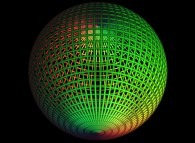
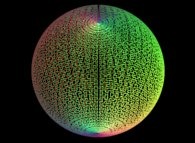
A sphere -positive curvature- ==> Bidimensional Hilbert Curve -iteration 7- ==> A sphere described by means of a Bidimensional Hilbert Curve -iteration 7-
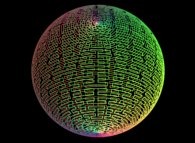
A sphere -positive curvature- ==> The Bidimensional [0,1] --> [0,1]x[0,1] Peano Surjection -T defined with 8 digits- ==> A sphere described by means of a Bidimensional Peano Curve -8 digits-
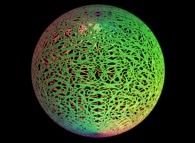
A sphere -positive curvature- ==> A Bidimensional Hilbert-like Curve defined with {X6(...),Y6(...)} -iteration 6- ==> A sphere described by means of a Bidimensional Hilbert-like Curve -iteration 6-


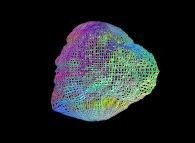
A 'crumpled' sphere defined by means of three bidimensional fields ==> Bidimensional Hilbert Curve -iteration 7- ==> A 'crumpled' sphere described by means of a Bidimensional Hilbert Curve -iteration 7-


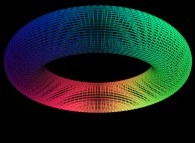
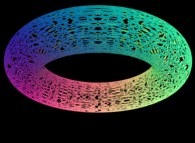
A torus ==> Bidimensional Hilbert Curve -iteration 7- ==> A torus described by means of a Bidimensional Hilbert Curve -iteration 7-
A torus ==> The Bidimensional [0,1] --> [0,1]x[0,1] Peano Surjection -T defined with 8 digits- ==> A torus described by means of a Bidimensional Peano Curve -8 digits-
A torus ==> A Bidimensional Hilbert-like Curve defined with {X6(...),Y6(...)} -iteration 6- ==> A torus described by means of a Bidimensional Hilbert-like Curve -iteration 6-


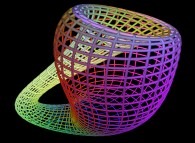
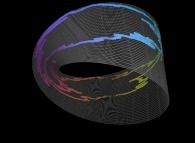
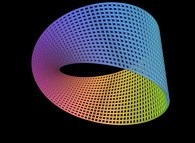
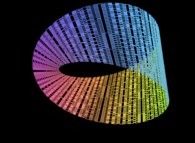
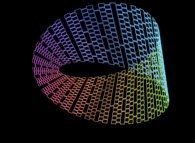
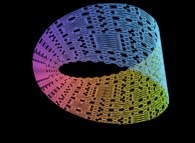
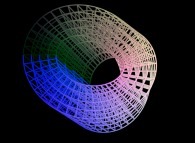
The Möbius strip ==> Bidimensional Hilbert Curve -iteration 7- ==> The Möbius strip described by means of a Bidimensional Hilbert Curve -iteration 7-
The Möbius strip ==> The Bidimensional [0,1] --> [0,1]x[0,1] Peano Surjection -T defined with 8 digits- ==> The Möbius strip described by means of a Bidimensional Peano Curve -8 digits-
The Möbius strip ==> A Bidimensional Hilbert-like Curve defined with {X6(...),Y6(...)} -iteration 6- ==> The Möbius strip described by means of a Bidimensional Hilbert-like Curve -iteration 6-


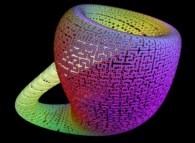
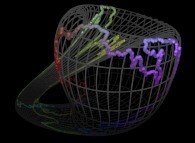
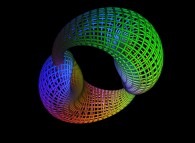
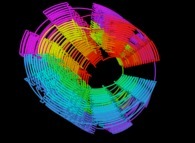
The Klein bottle ==> Bidimensional Hilbert Curve -iteration 7- ==> The Klein bottle described by means of a Bidimensional Hilbert Curve -iteration 7-
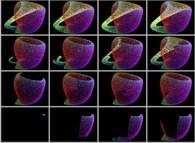
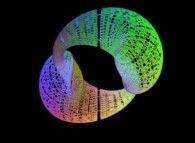
The Klein bottle ==> The construction of the bidimensional Hilbert Curve -iteration 4- ==> The construction of the Klein bottle described by means of a Bidimensional Hilbert Curve -iteration 7-
The Klein bottle ==> The Bidimensional [0,1] --> [0,1]x[0,1] Peano Surjection -T defined with 8 digits- ==> The Klein bottle described by means of a Bidimensional Peano Curve -8 digits-
The Klein bottle ==> A Bidimensional Hilbert-like Curve defined with {X6(...),Y6(...)} -iteration 6- ==> The Klein bottle described by means of a Bidimensional Hilbert-like Curve -iteration 6-
The Klein bottle ==> A Bidimensional Hilbert-like Curve defined with {X1(...),Y1(...)} related to the Mandelbrot set border -iteration 6- ==> The Klein bottle described by means of a Bidimensional Hilbert-like Curve -iteration 6-
The Klein bottle ==> A Bidimensional Hilbert-like Curve defined with {X1(...),Y1(...)} related to the von Koch Curve -iteration 6- ==> The Klein bottle described by means of a Bidimensional Hilbert-like Curve -iteration 6-
The Klein bottle ==> A Bidimensional Hilbert-like Curve defined with {X1(...),Y1(...)} related to the von Koch Curve -iteration 7- ==> The Klein bottle described by means of a Bidimensional Hilbert-like Curve -iteration 7-
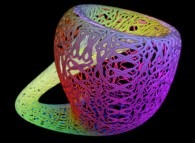
The Klein bottle ==> A Bidimensional Hilbert-like Curve defined with {X1(...),Y1(...)} related to a periodical impossible structure -iteration 5- ==> The Klein bottle described by means of a Bidimensional Hilbert-like Curve -iteration 5-
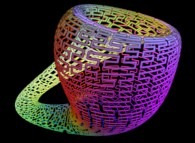
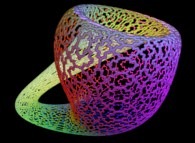
The Klein bottle ==> A Bidimensional non continous Hilbert-like Curve defined with {X1(...),Y1(...)} related to a periodical 'labyrinthic' structure -iteration 5- ==> The Klein bottle described by means of a Bidimensional non continous Hilbert-like Curve -iteration 5-


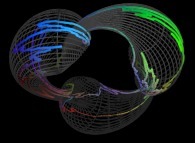
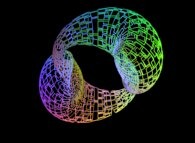
The Bonan-Jeener double bottle ==> Bidimensional Hilbert Curve -iteration 7- ==> The Bonan-Jeener double bottle described by means of a Bidimensional Hilbert Curve -iteration 7-
The Bonan-Jeener double bottle ==> The Bidimensional [0,1] --> [0,1]x[0,1] Peano Surjection -T defined with 8 digits- ==> The Bonan-Jeener double bottle described by means of a Bidimensional Peano Curve -8 digits-
The Bonan-Jeener double bottle ==> A Bidimensional Hilbert-like Curve defined with {X6(...),Y6(...)} -iteration 6- ==> The Bonan-Jeener double bottle described by means of a Bidimensional Hilbert-like Curve -iteration 6-


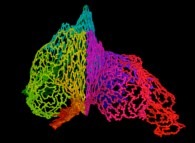
A 'fractal plane' with overhangings defined by means of three bidimensional fields ==> Bidimensional Hilbert Curve -iteration 7- ==> A 'fractal plane' with overhangings described by means of a Bidimensional Hilbert Curve -iteration 7-


A 'fractal plane' with overhangings defined by means of three bidimensional fields ==> Bidimensional Hilbert Curve -iteration 7- ==> A 'fractal plane' with overhangings described by means of a Bidimensional Hilbert Curve -iteration 7-


A 'fractal plane' with overhangings defined by means of three bidimensional fields ==> Bidimensional Hilbert Curve -iteration 7- ==> A 'fractal plane' with overhangings described by means of a Bidimensional Hilbert-like Curve -iteration 6-


Tridimensional representation of a quadridimensional Calabi-Yau manifold ==> Bidimensional Hilbert Curve -iteration 5- ==> Tridimensional representation of a quadridimensional Calabi-Yau manifold described by means of 5x5 Bidimensional Hilbert Curves -iteration 5-


4-Tridimensional Manifolds:

Many tridimensional manifolds in a tridimensional space can be defined using a set of three equations:
                    X = Fx(u,v,w)
                    Y = Fy(u,v,w)
                    Z = Fz(u,v,w)
with:
                    u  [Umin,Umax]
                    v  [Vmin,Vmax]
                    w  [Wmin,Wmax]
[Umin,Umax]*[Vmin,Vmax]*[Wmin,Wmax] then defined a tridimensional rectangular domain D.


It is obvious to generalize the preceding bidimensional process in the tridimensional space...


Here are some examples of this process :


Tridimensional Manifold==>C Curve==>Tridimensional Manifold filling Curve


A Ball ==> Tridimensional Hilbert Curve -iteration 2- ==> A Ball described by means of a Tridimensional Hilbert Curve -iteration 2-
A Ball ==> Tridimensional Hilbert Curve -iteration 3- ==> A Ball described by means of a Tridimensional Hilbert Curve -iteration 3-
A Ball ==> Tridimensional Hilbert Curve -iteration 4- ==> A Ball described by means of a Tridimensional Hilbert Curve -iteration 4-
A Ball ==> A Tridimensional Hilbert-like Curve defined with {X1(...),Y1(...),Z1(...)} -iteration 1- ==> A Ball described by means of a Tridimensional Hilbert-like Curve -iteration 1-
A Ball ==> A Tridimensional Hilbert-like Curve defined with {X2(...),Y2(...),Z2(...)} -iteration 2- ==> A Ball described by means of a Tridimensional Hilbert-like Curve -iteration 2-
A Ball ==> A Tridimensional Hilbert-like Curve defined with {X3(...),Y3(...),Z3(...)} -iteration 3- ==> A Ball described by means of a Tridimensional Hilbert-like Curve -iteration 3-
A Ball ==> A Tridimensional Hilbert-like Curve defined with {X4(...),Y4(...),Z4(...)} -iteration 4- ==> A Ball described by means of a Tridimensional Hilbert-like Curve -iteration 4-
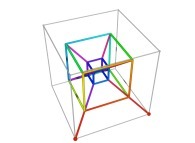
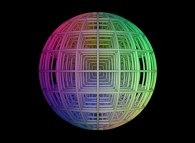
A Ball ==> A Tridimensional Hilbert-like Curve defined with {X1(...),Y1(...),Z1(...)} -iteration 1- ==> A Ball described by means of an hypercube -iteration 1-
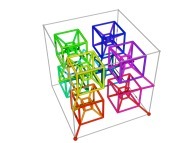
A Ball ==> A Tridimensional Hilbert-like Curve defined with {X2(...),Y2(...),Z2(...)} -iteration 2- ==> A Ball described by means of an hypercube -iteration 2-
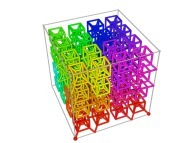
A Ball ==> A Tridimensional Hilbert-like Curve defined with {X3(...),Y3(...),Z3(...)} -iteration 3- ==> A Ball described by means of an hypercube -iteration 3-
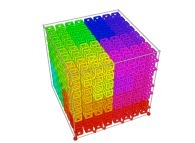
A Ball ==> A Tridimensional Hilbert-like Curve defined with {X4(...),Y4(...),Z4(...)} -iteration 4- ==> A Ball described by means of an hypercube -iteration 4-
A Ball ==> A Tridimensional Hilbert-like Curve defined with {X2(...),Y2(...),Z2(...)} and based on an 'open' 3-foil torus knot -iteration 2- ==> A Ball described by means of an 'open' 3-foil torus knot -iteration 2-
A Ball ==> A Tridimensional Hilbert-like Curve defined with {X3(...),Y3(...),Z3(...)} and based on an 'open' 3-foil torus knot -iteration 3- ==> A Ball described by means of an 'open' 3-foil torus knot -iteration 3-
A Ball ==> A Tridimensional Hilbert-like Curve defined with {X4(...),Y4(...),Z4(...)} and based on an 'open' 3-foil torus knot -iteration 4- ==> A Ball described by means of an 'open' 3-foil torus knot -iteration 4-


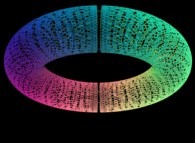
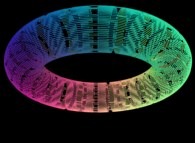
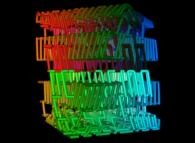
A parallelepipedic Hyper-Torus ==> Tridimensional Hilbert Curve -iteration 4- ==> A parallelepipedic Torus described by means of a Tridimensional Hilbert Curve -iteration 4-
A parallelepipedic Hyper-Torus ==> A Tridimensional Hilbert-like Curve defined with {X4(...),Y4(...),Z4(...)} and based on an 'open' 3-foil torus knot -iteration 4- ==> A parallelepipedic Torus described by means of an 'open' 3-foil torus knot -iteration 4-
A parallelepipedic Hyper-Torus ==> A Tridimensional Hilbert-like Curve defined with {X4(...),Y4(...),Z4(...)} -iteration 4- ==> A parallelepipedic Torus described by means of an hypercube -iteration 4-


A Jeener-Möbius tridimensional manifold ==> Tridimensional Hilbert Curve -iteration 4- ==> A Jeener-Möbius Tridimensional manifold described by means of a Tridimensional Hilbert Curve -iteration 4-


A Jeener-Möbius tridimensional manifold ==> Tridimensional Hilbert Curve -iteration 4- ==> A Jeener-Möbius Tridimensional manifold described by means of a Tridimensional Hilbert Curve -iteration 4-
A Jeener-Möbius tridimensional manifold ==> A Tridimensional Hilbert-like Curve defined with {X4(...),Y4(...),Z4(...)} and based on an 'open' 3-foil torus knot -iteration 4- ==> A Jeener-Möbius Tridimensional manifold described by means of an 'open' 3-foil torus knot -iteration 4-


5-Beyond:

Instead of using space-filling curves in order to fill the {u,v} and {u,v,w} bi- and tridimensional domains, obviously one can use any means available and, for example, the bi- and the tridimensional brownian motions respectively....


Here are some examples of these extended processes :
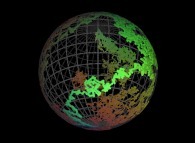

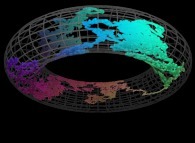
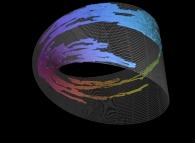
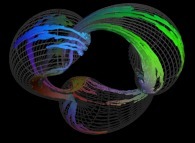
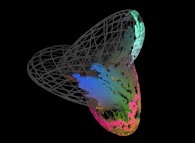
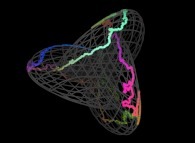
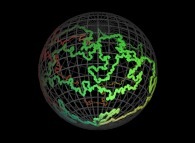
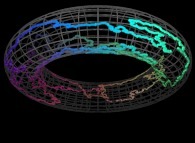
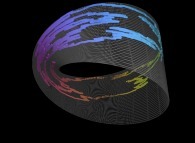
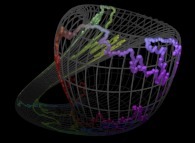
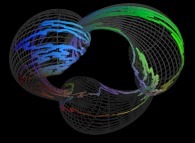
Bidimensional brownian motion on a sphere Bidimensional brownian motion on a torus Bidimensional brownian motion on the Möbius strip Bidimensional brownian motion on the Klein bottle Bidimensional brownian motion on the Bonan-Jeener-Klein triple bottle Bidimensional brownian motion on the Boy surface


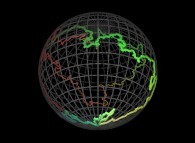
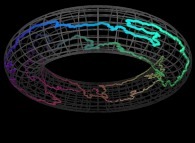
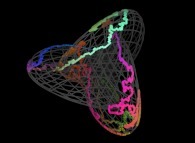
Bidimensional closed self-avoiding brownian motion on a sphere Bidimensional closed self-avoiding brownian motion on a torus Bidimensional closed self-avoiding brownian motion on the Möbius strip Bidimensional closed pseudo-self-avoiding brownian motion on the Klein bottle Bidimensional closed pseudo-self-avoiding brownian motion on the Bonan-Jeener-Klein triple bottle Bidimensional closed pseudo-self-avoiding brownian motion on the Boy surface


Copyright © Jean-François COLONNA, 2023-2026.
Copyright © CMAP (Centre de Mathématiques APpliquées) UMR CNRS 7641 / École polytechnique, Institut Polytechnique de Paris, 2023-2026.