Hilbert and Peano Space filling Curves and Beyond:
From Squares and Cubes to Surfaces (bidimensional Manifolds) and tridimensional Manifolds


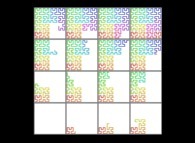
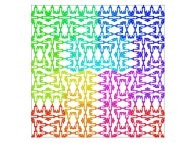
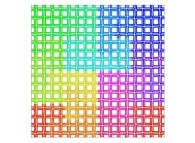
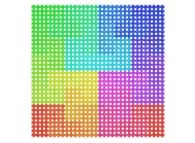
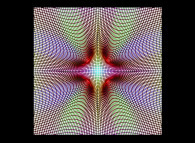
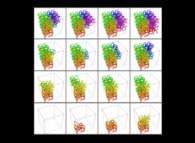
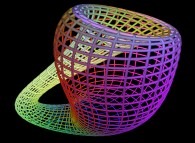
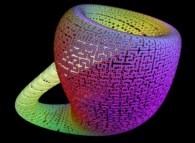
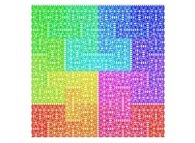
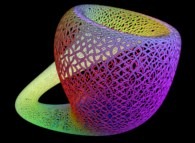
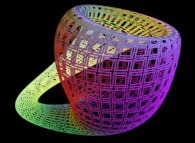
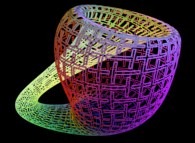
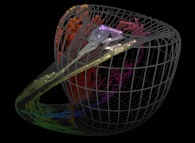
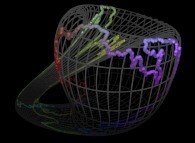
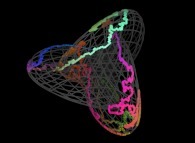
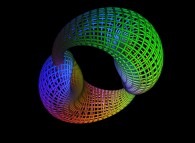
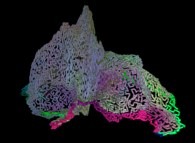
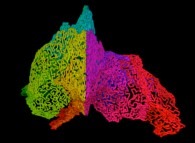
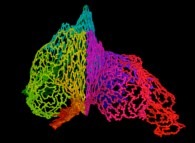
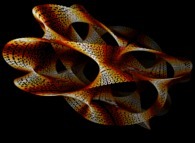
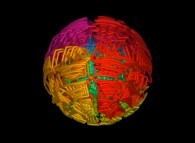
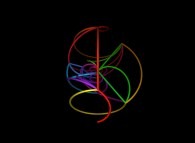
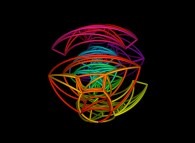
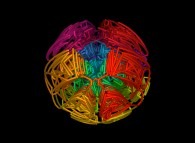
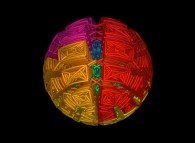
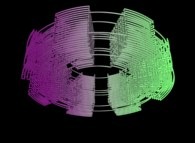
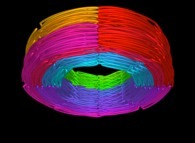
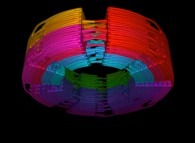
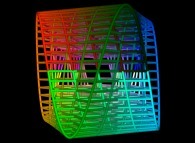
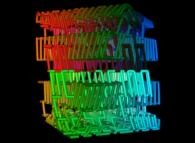
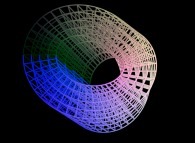
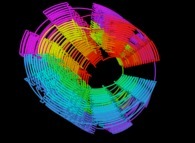
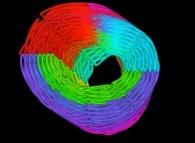
The Bonan-Jeener double bottle described by means of a Bidimensional Hilbert Curve -iteration 7-

Jean-François COLONNA
[Contact me]

www.lactamme.polytechnique.fr

CMAP (Centre de Mathématiques APpliquées) UMR CNRS 7641, École polytechnique, Institut Polytechnique de Paris, CNRS, France

[Site Map and Help [Plan du Site et Aide]]
[The Y2K Bug [Le bug de l'an 2000]]
[Are we ready for the Year 2038 [Notre informatique est-elle prête pour l'An 2038]?]
[Real Numbers don't exist in Computers and Floating Point Computations aren't safe. [Les Nombres Réels n'existent pas dans les Ordinateurs et les Calculs Flottants ne sont pas sûrs.]]
[Please, visit A Virtual Machine for Exploring Space-Time and Beyond, the place where you can find more than 10.000 pictures and animations between Art and Science]
(CMAP28 WWW site: this page was created on 01/03/2023 and last updated on 05/15/2026 19:20:50 -CEST-)


[en français/in french]


Contents:


1-The bidimensional Peano Surjection:

Giuseppe Peano defined the following surjection :
                    [0,1] --> [0,1]x[0,1]
Let's T being a real number defined using the base 3 :
                    T    = 0.A1A2A3...  [0,1] with Ai  {0,1,2}
Let's X(T) and Y(T) being two real functions of T defined as :
                    X(T) = 0.B1B2B3...  [0,1] with Bi  {0,1,2}
                    Y(T) = 0.C1C2C3...  [0,1] with Ci  {0,1,2}
with :
                    Bn = A2n-1 if A2+A4+...+A2n-0 is even
                    Bn = 2-A2n-1 otherwise

                    Cn = A2n if A1+A3+...+A2n-1 is even
                    Cn = 2-A2n otherwise


These two functions X(T) and Y(T) are the coordinates of a point P(T) inside the [0,1]x[0,1] square. The displayed "curve" -as little spheres- is the trajectory of P(T) when T varies from 0 (lower left corner) to 1-epsilon (upper right corner).


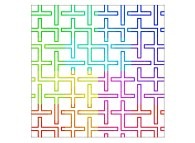
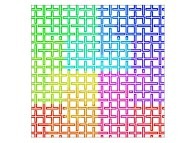
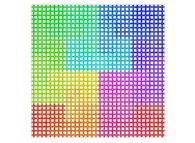
Here are the four first bidimensional Peano curves with an increasing number of digits {2,4,6,8}:

The Bidimensional [0,1] --> [0,1]x[0,1] Peano Surjection -T defined with 2 digits- The Bidimensional [0,1] --> [0,1]x[0,1] Peano Surjection -T defined with 4 digits- The [0,1] --> [0,1]x[0,1] Peano Surjection -T defined with 6 digits- The Bidimensional [0,1] --> [0,1]x[0,1] Peano Surjection -T defined with 8 digits- [See the used color set to display the parameter T]


2-The tridimensional Peano Surjection:

A tridimensional surjection can be defined :
                    [0,1] --> [0,1]x[0,1]x[0,1]
as a generalization of the bidimensional one.

Let's T being a real number defined using the base 3 :
                    T    = 0.A1A2A3...  [0,1] with Ai  {0,1,2}
Let's X(T), Y(T) and Z(T) being three real functions of T defined as:
                    X(T) = 0.B1B2B3...  [0,1] with Bi  {0,1,2}
                    Y(T) = 0.C1C2C3...  [0,1] with Ci  {0,1,2}
                    Y(T) = 0.D1D2D3...  [0,1] with Di  {0,1,2}
with :
                    Bn = A3n-2 if A3+A6+...+A3n-0 is even
                    Bn = 2-A3n-2 otherwise

                    Cn = A3n-1 if A2+A5+...+A3n-1 is even
                    Cn = 2-A3n-1 otherwise

                    Dn = A3n if A1+A4+...+A3n-2 is even
                    Dn = 2-A3n otherwise


These three functions X(T), Y(T) and Z(T) are the coordinates of a point P(T) inside the [0,1]x[0,1]x[0,1] cube. The displayed "curve" is the trajectory of P(T) -displayed as little spheres- when T varies from 0 (lower left corner) to 1-epsilon (upper right corner).


Here are the three first tridimensional Peano curves with an increasing number of digits {3,6,9}:

The Tridimensional [0,1] --> [0,1]x[0,1]x[0,1] Peano Surjection -T defined with 3 digits- The Tridimensional [0,1] --> [0,1]x[0,1]x[0,1] Peano Surjection -T defined with 6 digits- The Tridimensional [0,1] --> [0,1]x[0,1]x[0,1] Peano Surjection -T defined with 9 digits- [See the used color set to display the parameter T]


3-The bidimensional Hilbert Curves:

Let's C1(T) being a parametric curve defined by means of 2 real functions of T (T [0,1]) X1(T) [0,1] and Y1(T) [0,1] such as :
                    X1(T=0)=0 Y1(T=0)=0 (lower left corner)
                    X1(T=1)=1 Y1(T=1)=0 (lower right corner)


Then one defines a sequence of curves Ci(T) (i >= 1) as follows :
                    Ci(T) = {Xi(T),Yi(T)}  [0,1]x[0,1] --> Ci+1(T) = {Xi+1(T),Yi+1(T)}  [0,1]x[0,1]

                    if T  [0,1/4[:
                              Xi+1(T) =   Yi(4T-0)
                              Yi+1(T) =   Xi(4T-0)
                                                   Transformation 1
                    if T  [1/4,2/4[:
                              Xi+1(T) =   Xi(4T-1)
                              Yi+1(T) = 1+Yi(4T-1)
                                                   Transformation 2
                    if T  [2/4,3/4[:
                              Xi+1(T) = 1+Xi(4T-2)
                              Yi+1(T) = 1+Yi(4T-2)
                                                   Transformation 3
                    if T  [3/4,1]:
                              Xi+1(T) = 2-Yi(4T-3)
                              Yi+1(T) = 1-Xi(4T-3)
                                                   Transformation 4

Please note that 4=2d where d=2 is the space dimension.


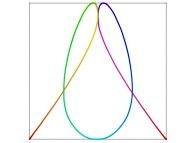
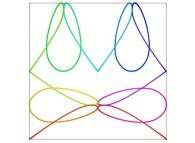
See a special C1(T) curve A Bidimensional Hilbert-like Curve defined with {X1(...),Y1(...)} -iteration 1- in order to understand the geometrical meaning of the 4 transformations A Bidimensional Hilbert-like Curve defined with {X2(...),Y2(...)} -iteration 2- and of their order Bidimensional Hilbert Curve -iteration 1- .
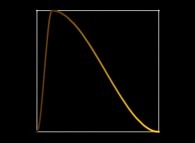
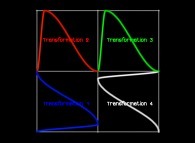

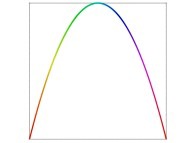
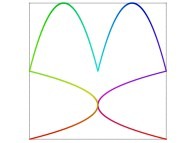
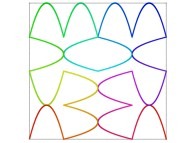
Here are the five first bidimensional Hilbert curves with an increasing number of iterations :
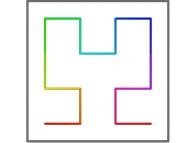
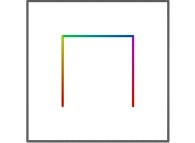
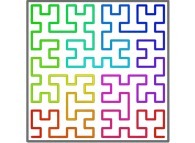
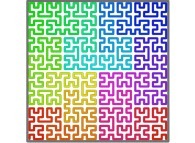
Bidimensional Hilbert Curve -iteration 1- Bidimensional Hilbert Curve -iteration 2- Bidimensional Hilbert Curve -iteration 3- Bidimensional Hilbert Curve -iteration 4- Bidimensional Hilbert Curve -iteration 5- [See the used color set to display the parameter T]

See the construction of some of them :

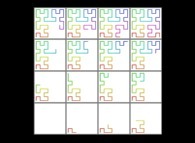
Empty Empty The construction of the bidimensional Hilbert Curve -iteration 3- The construction of the bidimensional Hilbert Curve -iteration 4- Empty


Here are some examples of Hilbert-like bidimensional curves using different generating curves :

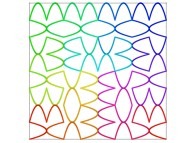
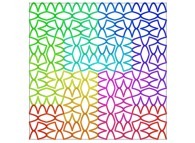
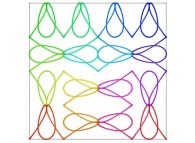
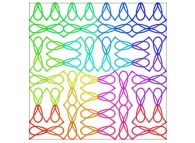
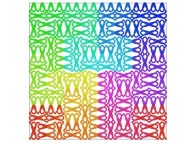
A Bidimensional Hilbert-like Curve defined with {X1(...),Y1(...)} -iteration 1- A Bidimensional Hilbert-like Curve defined with {X2(...),Y2(...)} -iteration 2- A Bidimensional Hilbert-like Curve defined with {X3(...),Y3(...)} -iteration 3- A Bidimensional Hilbert-like Curve defined with {X4(...),Y4(...)} -iteration 4- A Bidimensional Hilbert-like Curve defined with {X5(...),Y5(...)} -iteration 5-
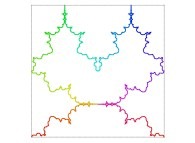
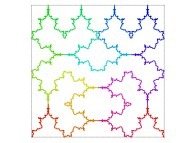
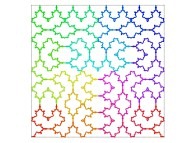
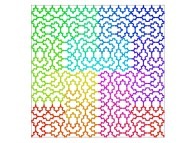
A Bidimensional Hilbert-like Curve defined with {X1(...),Y1(...)} related to the Mandelbrot set border -iteration 1- A Bidimensional Hilbert-like Curve defined with {X1(...),Y1(...)} related to the Mandelbrot set border -iteration 2- A Bidimensional Hilbert-like Curve defined with {X1(...),Y1(...)} related to the Mandelbrot set border -iteration 3- A Bidimensional Hilbert-like Curve defined with {X1(...),Y1(...)} related to the Mandelbrot set border -iteration 4- A Bidimensional Hilbert-like Curve defined with {X1(...),Y1(...)} related to the Mandelbrot set border -iteration 5-
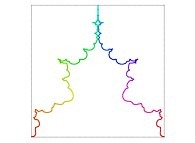
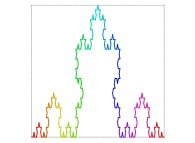
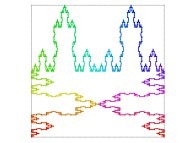
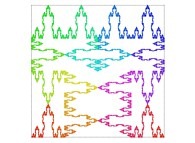
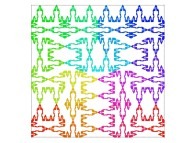
A Bidimensional Hilbert-like Curve defined with {X1(...),Y1(...)} related to the von Koch Curve -iteration 1- A Bidimensional Hilbert-like Curve defined with {X1(...),Y1(...)} related to the von Koch Curve -iteration 2- A Bidimensional Hilbert-like Curve defined with {X1(...),Y1(...)} related to the von Koch Curve -iteration 3- A Bidimensional Hilbert-like Curve defined with {X1(...),Y1(...)} related to the von Koch Curve -iteration 4- A Bidimensional Hilbert-like Curve defined with {X1(...),Y1(...)} related to the von Koch Curve -iteration 5-
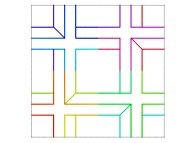
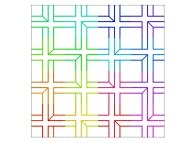
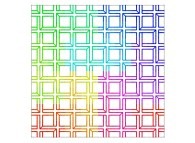
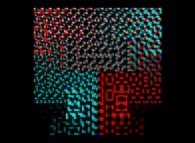
A Bidimensional Hilbert-like Curve defined with {X1(...),Y1(...)} related to a periodical impossible structure -iteration 1- A Bidimensional Hilbert-like Curve defined with {X1(...),Y1(...)} related to a periodical impossible structure -iteration 2- A Bidimensional Hilbert-like Curve defined with {X1(...),Y1(...)} related to a periodical impossible structure -iteration 3- A Bidimensional Hilbert-like Curve defined with {X1(...),Y1(...)} related to a periodical impossible structure -iteration 4- A Bidimensional Hilbert-like Curve defined with {X1(...),Y1(...)} related to a periodical impossible structure -iteration 5-
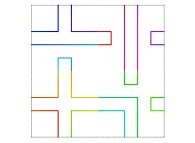
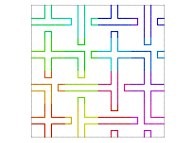
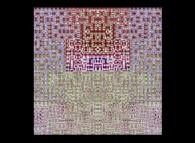
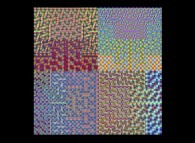
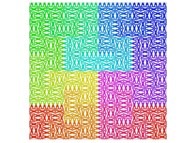
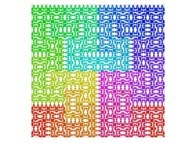
A Bidimensional non continous Hilbert-like Curve defined with {X1(...),Y1(...)} related to a periodical 'labyrinthic' structure -iteration 1- A Bidimensional non continous Hilbert-like Curve defined with {X1(...),Y1(...)} related to a periodical 'labyrinthic' structure -iteration 2- A Bidimensional non continous Hilbert-like Curve defined with {X1(...),Y1(...)} related to a periodical 'labyrinthic' structure -iteration 3- A Bidimensional non continous Hilbert-like Curve defined with {X1(...),Y1(...)} related to a periodical 'labyrinthic' structure -iteration 4- A Bidimensional non continous Hilbert-like Curve defined with {X1(...),Y1(...)} related to a periodical 'labyrinthic' structure -iteration 5-


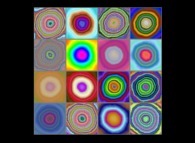
Here is the "mapping" of a few pictures by means of a bidimensional Hilbert curve: :

Untitled 0598 -a Tribute to Robert & Sonia Delaunay- ==>
[iteration 11]
Untitled 0639
Untitled 0198 ==>
[iteration 10]
Untitled 0638
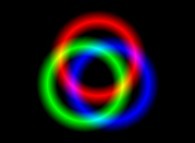
Rings ==>
[iteration 9]
Untitled 0637
Untitled 0265 -a Tribute to Vassily Kandinsky- ==>
[iteration 10]
Untitled 0636


4-The tridimensional Hilbert Curves:

Let's C1(T) being a parametric curve defined by means of 3 real functions of T (T [0,1]) X1(T) [0,1], Y1(T) [0,1] and Z1(T) [0,1] such as :
                    X1(T=0)=0 Y1(T=0)=0 Z1(T=0)=0 (lower left foreground corner)
                    X1(T=1)=1 Y1(T=1)=0 Z1(T=1)=0 (lower right foreground corner)


Then one defines a sequence of curves Ci(T) (i >= 1) as follows :
                    Ci(T) = {Xi(T),Yi(T),Zi(T)}  [0,1]x[0,1]x[0,1] --> Ci+1(T) = {Xi+1(T),Yi+1(T),Zi+1(T)}  [0,1]x[0,1]x[0,1]

                    if T  [0,1/8[:
                              Xi+1(T) =   Xi(8T-0)
                              Yi+1(T) =   Zi(8T-0)
                              Zi+1(T) =   Yi(8T-0)
                                                   Transformation 1
                    if T  [1/8,2/8[:
                              Xi+1(T) =   Zi(8T-1)
                              Yi+1(T) = 1+Yi(8T-1)
                              Zi+1(T) =   Xi(8T-1)
                                                   Transformation 2
                    if T  [2/8,3/8[:
                              Xi+1(T) = 1+Xi(8T-2)
                              Yi+1(T) = 1+Yi(8T-2)
                              Zi+1(T) =   Zi(8T-2)
                                                   Transformation 3
                    if T  [3/8,4/8[:
                              Xi+1(T) = 1+Zi(8T-3)
                              Yi+1(T) = 1-Xi(8T-3)
                              Zi+1(T) = 1-Yi(8T-3)
                                                   Transformation 4
                    if T  [4/8,5/8[:
                              Xi+1(T) = 2-Zi(8T-4)
                              Yi+1(T) = 1-Xi(8T-4)
                              Zi+1(T) = 1+Yi(8T-4)
                                                   Transformation 5
                    if T  [5/8,6/8[:
                              Xi+1(T) = 1+Xi(8T-5)
                              Yi+1(T) = 1+Yi(8T-5)
                              Zi+1(T) = 1+Zi(8T-5)
                                                   Transformation 6
                    if T  [6/8,7/8[:
                              Xi+1(T) = 1-Zi(8T-6)
                              Yi+1(T) = 1+Yi(8T-6)
                              Zi+1(T) = 2-Xi(8T-6)
                                                   Transformation 7
                    if T  [7/8,1]:
                              Xi+1(T) =   Xi(8T-7)
                              Yi+1(T) = 1-Zi(8T-7)
                              Zi+1(T) = 2-Yi(8T-7)
                                                   Transformation 8

Please note that 8=2d where d=3 is the space dimension.


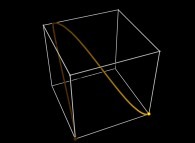
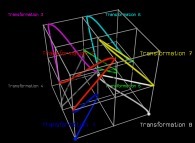
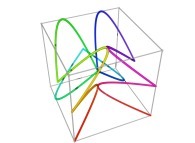
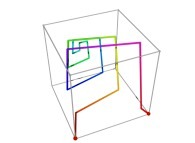
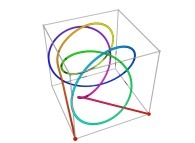
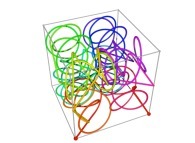
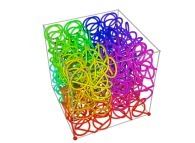
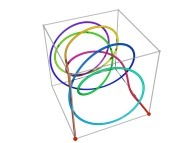
See a special C1(T) curve A Tridimensional Hilbert-like Curve defined with {X1(...),Y1(...),Z1(...)} -iteration 1- in order to understand the geometrical meaning of the 8 transformations A Tridimensional Hilbert-like Curve defined with {X2(...),Y2(...),Z2(...)} -iteration 2- and of their order Tridimensional Hilbert Curve -iteration 1- .


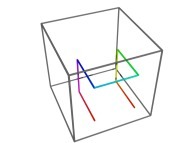
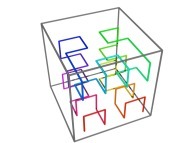
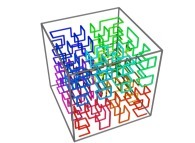
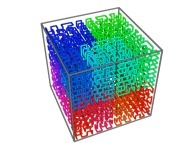
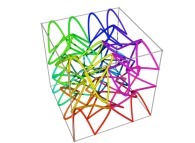
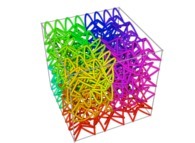
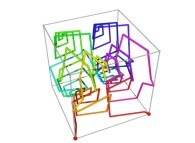
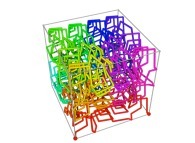
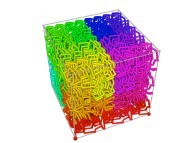
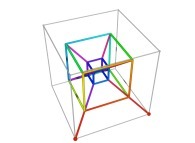
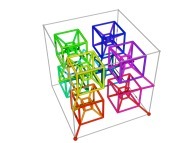
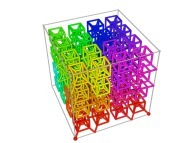
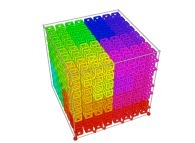
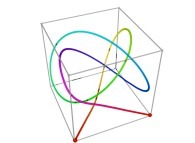
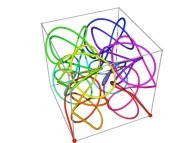
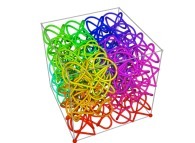
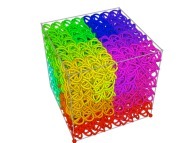
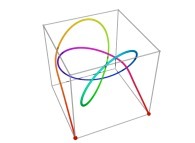
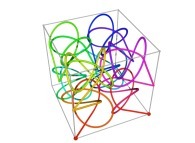
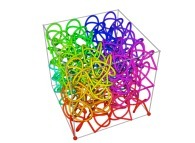
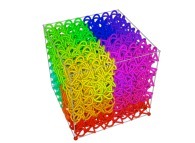
Here are the four first tridimensional Hilbert curves with an increasing number of iterations :
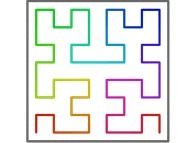
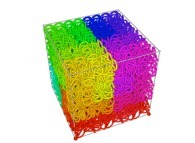
Tridimensional Hilbert Curve -iteration 1- Tridimensional Hilbert Curve -iteration 2- Tridimensional Hilbert Curve -iteration 3- Tridimensional Hilbert Curve -iteration 4- [See the used color set to display the parameter T]

See the construction of one of them :
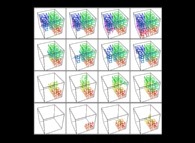
Empty Empty The construction of the tridimensional Hilbert Curve -iteration 3- Empty


Here are some examples of Hilbert-like tridimensional curves using different generating curves and in particular "open" knots :
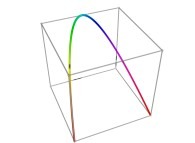
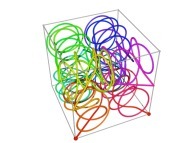
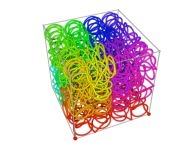
A Tridimensional Hilbert-like Curve defined with {X1(...),Y1(...),Z1(...)} -iteration 1- A Tridimensional Hilbert-like Curve defined with {X2(...),Y2(...),Z2(...)} -iteration 2- A Tridimensional Hilbert-like Curve defined with {X3(...),Y3(...),Z3(...)} -iteration 3- A Tridimensional Hilbert-like Curve defined with {X4(...),Y4(...),Z4(...)} -iteration 4-
Empty Empty The construction of a tridimensional Hilbert-like Curve defined with {X3(...),Y3(...),Z3(...)} and based on an 'open' 3-foil torus knot -iteration 3- Empty
A Tridimensional Hilbert-like Curve defined with {X1(...),Y1(...),Z1(...)} and based on an 'open' 3-foil torus knot -iteration 1- A Tridimensional Hilbert-like Curve defined with {X2(...),Y2(...),Z2(...)} and based on an 'open' 3-foil torus knot -iteration 2- A Tridimensional Hilbert-like Curve defined with {X3(...),Y3(...),Z3(...)} and based on an 'open' 3-foil torus knot -iteration 3- A Tridimensional Hilbert-like Curve defined with {X4(...),Y4(...),Z4(...)} and based on an 'open' 3-foil torus knot -iteration 4-
Empty Empty The construction of a tridimensional Hilbert-like Curve defined with {X3(...),Y3(...),Z3(...)} and based on an 'open' 3-foil torus knot -iteration 3- Empty
A Tridimensional Hilbert-like Curve defined with {X1(...),Y1(...),Z1(...)} and based on an 'open' 5-foil torus knot -iteration 1- A Tridimensional Hilbert-like Curve defined with {X2(...),Y2(...),Z2(...)} and based on an 'open' 5-foil torus knot -iteration 2- A Tridimensional Hilbert-like Curve defined with {X3(...),Y3(...),Z3(...)} and based on an 'open' 5-foil torus knot -iteration 3- A Tridimensional Hilbert-like Curve defined with {X4(...),Y4(...),Z4(...)} and based on an 'open' 5-foil torus knot -iteration 4-
A Tridimensional Hilbert-like Curve defined with {X1(...),Y1(...),Z1(...)} and based on an 'open' 7-foil torus knot -iteration 1- A Tridimensional Hilbert-like Curve defined with {X2(...),Y2(...),Z2(...)} and based on an 'open' 7-foil torus knot -iteration 2- A Tridimensional Hilbert-like Curve defined with {X3(...),Y3(...),Z3(...)} and based on an 'open' 7-foil torus knot -iteration 3- A Tridimensional Hilbert-like Curve defined with {X4(...),Y4(...),Z4(...)} and based on an 'open' 7-foil torus knot -iteration 4-

[More information about Peano Curves and Infinite Knots -in english/en anglais-]
[Plus d'informations à propos des Courbes de Peano et des Nœuds Infinis -en français/in french-]


5-Tridimensional Surfaces (Bidimensional Manifolds):

Many surfaces -bidimensional manifolds- in a tridimensional space can be defined using a set of three equations:
                    X = Fx(u,v)
                    Y = Fy(u,v)
                    Z = Fz(u,v)
with:
                    u  [Umin,Umax]
                    v  [Vmin,Vmax]
For example:
                    Fx(u,v) = R.sin(u).cos(v)
                    Fy(u,v) = R.sin(u).sin(v)
                    Fz(u,v) = R.cos(u)
with:
                     u  [0,pi]
                     v  [0,2.pi]
defines a sphere with R as the radius and the origin of the coordinates as the center.


[Umin,Umax]*[Vmin,Vmax] then defined a bidimensional rectangular domain D.
                       v ^
                         |
                    V    |...... ---------------------------
                     max |      |+++++++++++++++++++++++++++|
                         |      |+++++++++++++++++++++++++++|
                         |      |+++++++++++++++++++++++++++|
                         |      |+++++++++++++++++++++++++++|
                         |      |+++++++++++++++++++++++++++|
                         |      |+++++++++++++++++++++++++++|
                         |      |+++++++++++++++++++++++++++|
                         |      |+++++++++++++++++++++++++++|
                         |      |+++++++++++++++++++++++++++|
                    V    |...... ---------------------------
                     min |      :                           :
                         |      :                           :
                         O------------------------------------------------->
                                U                           U              u
                                 min                         max


Let's define a curve that fills the [0,1]x[0,1] square :
                         ^
                         |
                       1 |---------------
                         | +++++   +++++ |
                         | +   +   +   + |
                         | +   +++++   + |
                         | +           + |
                         | +++++   +++++ |
                         |     +   +     |
                         | +++++   +++++ |
                       0 O------------------------>
                         0               1


Obviously one can define a mapping between the [0,1]x[0,1] square and the [Umin,Umax]*[Vmin,Vmax] domain :
                       v ^
                         |
                    V    |...... ---------------------------
                     max |      | ++++++++         ++++++++ |
                         |      | +      +         +      + |
                         |      | +      +         +      + |
                         |      | +      +++++++++++      + |
                         |      | +           C           + |
                         |      | ++++++++         ++++++++ |
                         |      |        +         +        |
                         |      |        +         +        |
                         |      | ++++++++         ++++++++ |
                    V    |...... ---------------------------
                     min |      :                           :
                         |      :                           :
                         O------------------------------------------------->
                                U                           U              u
                                 min                         max
Then it suffices to display only the points {Fx(u,v),Fy(u,v),Fz(u,v)} with {u,v} on the preceding curve C to fill the surface with C....


Here are some examples of this process :


Surface==>C Curve==>Surface filling Curve


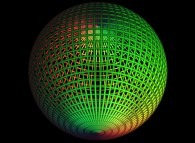
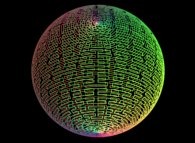
A sphere -positive curvature- ==> Bidimensional Hilbert Curve -iteration 7- ==> A sphere described by means of a Bidimensional Hilbert Curve -iteration 7-
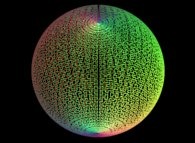
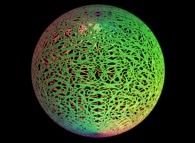
A sphere -positive curvature- ==> The Bidimensional [0,1] --> [0,1]x[0,1] Peano Surjection -T defined with 8 digits- ==> A sphere described by means of a Bidimensional Peano Curve -8 digits-
A sphere -positive curvature- ==> A Bidimensional Hilbert-like Curve defined with {X6(...),Y6(...)} -iteration 6- ==> A sphere described by means of a Bidimensional Hilbert-like Curve -iteration 6-


A 'crumpled' sphere defined by means of three bidimensional fields ==> Bidimensional Hilbert Curve -iteration 7- ==> A 'crumpled' sphere described by means of a Bidimensional Hilbert Curve -iteration 7-


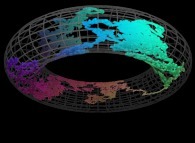
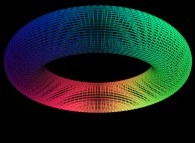
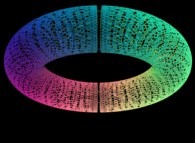
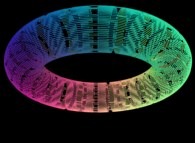
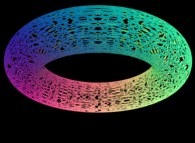
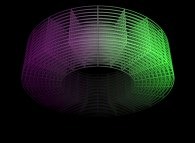
A torus ==> Bidimensional Hilbert Curve -iteration 7- ==> A torus described by means of a Bidimensional Hilbert Curve -iteration 7-
A torus ==> The Bidimensional [0,1] --> [0,1]x[0,1] Peano Surjection -T defined with 8 digits- ==> A torus described by means of a Bidimensional Peano Curve -8 digits-
A torus ==> A Bidimensional Hilbert-like Curve defined with {X6(...),Y6(...)} -iteration 6- ==> A torus described by means of a Bidimensional Hilbert-like Curve -iteration 6-


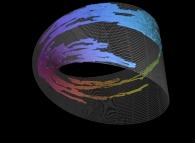
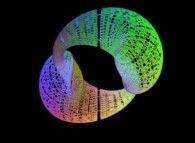
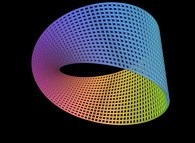
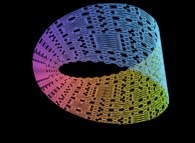
The Möbius strip ==> Bidimensional Hilbert Curve -iteration 7- ==> The Möbius strip described by means of a Bidimensional Hilbert Curve -iteration 7-
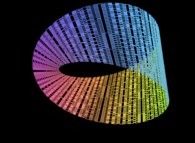
The Möbius strip ==> The Bidimensional [0,1] --> [0,1]x[0,1] Peano Surjection -T defined with 8 digits- ==> The Möbius strip described by means of a Bidimensional Peano Curve -8 digits-
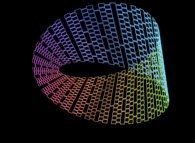
The Möbius strip ==> A Bidimensional Hilbert-like Curve defined with {X6(...),Y6(...)} -iteration 6- ==> The Möbius strip described by means of a Bidimensional Hilbert-like Curve -iteration 6-


The Klein bottle ==> Bidimensional Hilbert Curve -iteration 7- ==> The Klein bottle described by means of a Bidimensional Hilbert Curve -iteration 7-
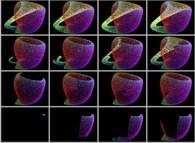
The Klein bottle ==> The construction of the bidimensional Hilbert Curve -iteration 4- ==> The construction of the Klein bottle described by means of a Bidimensional Hilbert Curve -iteration 7-
The Klein bottle ==> The Bidimensional [0,1] --> [0,1]x[0,1] Peano Surjection -T defined with 8 digits- ==> The Klein bottle described by means of a Bidimensional Peano Curve -8 digits-
The Klein bottle ==> A Bidimensional Hilbert-like Curve defined with {X6(...),Y6(...)} -iteration 6- ==> The Klein bottle described by means of a Bidimensional Hilbert-like Curve -iteration 6-
The Klein bottle ==> A Bidimensional Hilbert-like Curve defined with {X1(...),Y1(...)} related to the Mandelbrot set border -iteration 6- ==> The Klein bottle described by means of a Bidimensional Hilbert-like Curve -iteration 6-
The Klein bottle ==> A Bidimensional Hilbert-like Curve defined with {X1(...),Y1(...)} related to the von Koch Curve -iteration 6- ==> The Klein bottle described by means of a Bidimensional Hilbert-like Curve -iteration 6-
The Klein bottle ==> A Bidimensional Hilbert-like Curve defined with {X1(...),Y1(...)} related to the von Koch Curve -iteration 7- ==> The Klein bottle described by means of a Bidimensional Hilbert-like Curve -iteration 7-
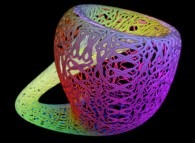
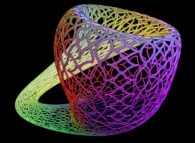
The Klein bottle ==> A Bidimensional Hilbert-like Curve defined with {X1(...),Y1(...)} related to a periodical impossible structure -iteration 5- ==> The Klein bottle described by means of a Bidimensional Hilbert-like Curve -iteration 5-
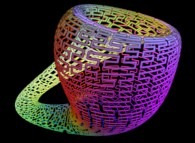
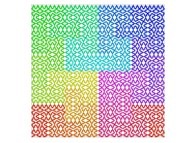
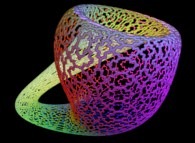
The Klein bottle ==> A Bidimensional non continous Hilbert-like Curve defined with {X1(...),Y1(...)} related to a periodical 'labyrinthic' structure -iteration 5- ==> The Klein bottle described by means of a Bidimensional non continous Hilbert-like Curve -iteration 5-


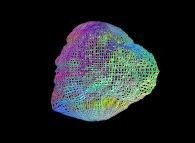
The Bonan-Jeener double bottle ==> Bidimensional Hilbert Curve -iteration 7- ==> The Bonan-Jeener double bottle described by means of a Bidimensional Hilbert Curve -iteration 7-
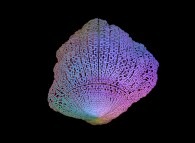
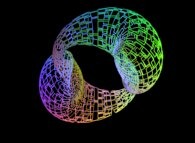
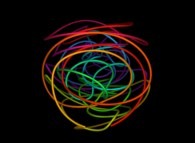
The Bonan-Jeener double bottle ==> The Bidimensional [0,1] --> [0,1]x[0,1] Peano Surjection -T defined with 8 digits- ==> The Bonan-Jeener double bottle described by means of a Bidimensional Peano Curve -8 digits-
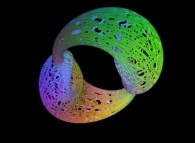
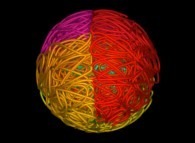
The Bonan-Jeener double bottle ==> A Bidimensional Hilbert-like Curve defined with {X6(...),Y6(...)} -iteration 6- ==> The Bonan-Jeener double bottle described by means of a Bidimensional Hilbert-like Curve -iteration 6-


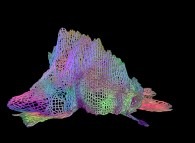
A 'fractal plane' with overhangings defined by means of three bidimensional fields ==> Bidimensional Hilbert Curve -iteration 7- ==> A 'fractal plane' with overhangings described by means of a Bidimensional Hilbert Curve -iteration 7-


A 'fractal plane' with overhangings defined by means of three bidimensional fields ==> Bidimensional Hilbert Curve -iteration 7- ==> A 'fractal plane' with overhangings described by means of a Bidimensional Hilbert Curve -iteration 7-


A 'fractal plane' with overhangings defined by means of three bidimensional fields ==> Bidimensional Hilbert Curve -iteration 7- ==> A 'fractal plane' with overhangings described by means of a Bidimensional Hilbert-like Curve -iteration 6-


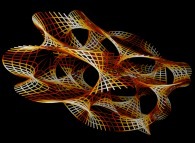
Tridimensional representation of a quadridimensional Calabi-Yau manifold ==> Bidimensional Hilbert Curve -iteration 5- ==> Tridimensional representation of a quadridimensional Calabi-Yau manifold described by means of 5x5 Bidimensional Hilbert Curves -iteration 5-


6-Tridimensional Manifolds:

Many tridimensional manifolds in a tridimensional space can be defined using a set of three equations:
                    X = Fx(u,v,w)
                    Y = Fy(u,v,w)
                    Z = Fz(u,v,w)
with:
                    u  [Umin,Umax]
                    v  [Vmin,Vmax]
                    w  [Wmin,Wmax]
[Umin,Umax]*[Vmin,Vmax]*[Wmin,Wmax] then defined a tridimensional rectangular domain D.


It is obvious to generalize the preceding bidimensional process in the tridimensional space...


Here are some examples of this process :


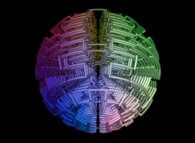
Tridimensional Manifold==>C Curve==>Tridimensional Manifold filling Curve


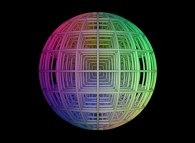
A Ball ==> Tridimensional Hilbert Curve -iteration 2- ==> A Ball described by means of a Tridimensional Hilbert Curve -iteration 2-
A Ball ==> Tridimensional Hilbert Curve -iteration 3- ==> A Ball described by means of a Tridimensional Hilbert Curve -iteration 3-
A Ball ==> Tridimensional Hilbert Curve -iteration 4- ==> A Ball described by means of a Tridimensional Hilbert Curve -iteration 4-
A Ball ==> A Tridimensional Hilbert-like Curve defined with {X1(...),Y1(...),Z1(...)} -iteration 1- ==> A Ball described by means of a Tridimensional Hilbert-like Curve -iteration 1-
A Ball ==> A Tridimensional Hilbert-like Curve defined with {X2(...),Y2(...),Z2(...)} -iteration 2- ==> A Ball described by means of a Tridimensional Hilbert-like Curve -iteration 2-
A Ball ==> A Tridimensional Hilbert-like Curve defined with {X3(...),Y3(...),Z3(...)} -iteration 3- ==> A Ball described by means of a Tridimensional Hilbert-like Curve -iteration 3-
A Ball ==> A Tridimensional Hilbert-like Curve defined with {X4(...),Y4(...),Z4(...)} -iteration 4- ==> A Ball described by means of a Tridimensional Hilbert-like Curve -iteration 4-
A Ball ==> A Tridimensional Hilbert-like Curve defined with {X1(...),Y1(...),Z1(...)} -iteration 1- ==> A Ball described by means of an hypercube -iteration 1-
A Ball ==> A Tridimensional Hilbert-like Curve defined with {X2(...),Y2(...),Z2(...)} -iteration 2- ==> A Ball described by means of an hypercube -iteration 2-
A Ball ==> A Tridimensional Hilbert-like Curve defined with {X3(...),Y3(...),Z3(...)} -iteration 3- ==> A Ball described by means of an hypercube -iteration 3-
A Ball ==> A Tridimensional Hilbert-like Curve defined with {X4(...),Y4(...),Z4(...)} -iteration 4- ==> A Ball described by means of an hypercube -iteration 4-
A Ball ==> A Tridimensional Hilbert-like Curve defined with {X2(...),Y2(...),Z2(...)} and based on an 'open' 3-foil torus knot -iteration 2- ==> A Ball described by means of an 'open' 3-foil torus knot -iteration 2-
A Ball ==> A Tridimensional Hilbert-like Curve defined with {X3(...),Y3(...),Z3(...)} and based on an 'open' 3-foil torus knot -iteration 3- ==> A Ball described by means of an 'open' 3-foil torus knot -iteration 3-
A Ball ==> A Tridimensional Hilbert-like Curve defined with {X4(...),Y4(...),Z4(...)} and based on an 'open' 3-foil torus knot -iteration 4- ==> A Ball described by means of an 'open' 3-foil torus knot -iteration 4-


A parallelepipedic Hyper-Torus ==> Tridimensional Hilbert Curve -iteration 4- ==> A parallelepipedic Torus described by means of a Tridimensional Hilbert Curve -iteration 4-
A parallelepipedic Hyper-Torus ==> A Tridimensional Hilbert-like Curve defined with {X4(...),Y4(...),Z4(...)} and based on an 'open' 3-foil torus knot -iteration 4- ==> A parallelepipedic Torus described by means of an 'open' 3-foil torus knot -iteration 4-
A parallelepipedic Hyper-Torus ==> A Tridimensional Hilbert-like Curve defined with {X4(...),Y4(...),Z4(...)} -iteration 4- ==> A parallelepipedic Torus described by means of an hypercube -iteration 4-


A Jeener-Möbius tridimensional manifold ==> Tridimensional Hilbert Curve -iteration 4- ==> A Jeener-Möbius Tridimensional manifold described by means of a Tridimensional Hilbert Curve -iteration 4-


A Jeener-Möbius tridimensional manifold ==> Tridimensional Hilbert Curve -iteration 4- ==> A Jeener-Möbius Tridimensional manifold described by means of a Tridimensional Hilbert Curve -iteration 4-
A Jeener-Möbius tridimensional manifold ==> A Tridimensional Hilbert-like Curve defined with {X4(...),Y4(...),Z4(...)} and based on an 'open' 3-foil torus knot -iteration 4- ==> A Jeener-Möbius Tridimensional manifold described by means of an 'open' 3-foil torus knot -iteration 4-


7-Beyond:

Instead of using space-filling curves in order to fill the {u,v} and {u,v,w} bi- and tridimensional domains, obviously one can use any means available and, for example, the bi- and the tridimensional brownian motions respectively....


Here are some examples of these extended processes :
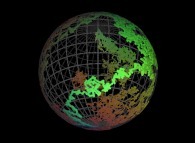

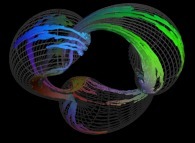
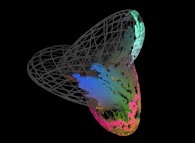
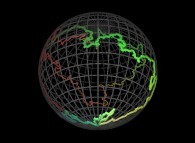
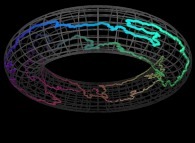
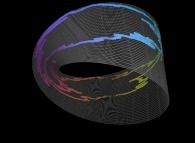
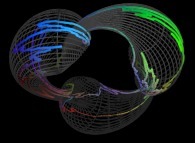
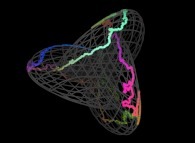
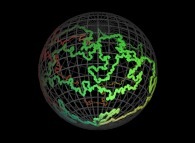
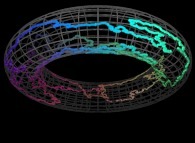
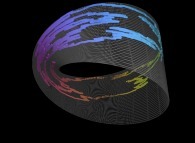
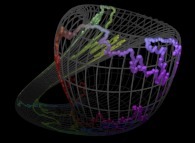
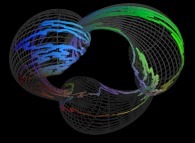
Bidimensional brownian motion on a sphere Bidimensional brownian motion on a torus Bidimensional brownian motion on the Möbius strip Bidimensional brownian motion on the Klein bottle Bidimensional brownian motion on the Bonan-Jeener-Klein triple bottle Bidimensional brownian motion on the Boy surface


Bidimensional closed self-avoiding brownian motion on a sphere Bidimensional closed self-avoiding brownian motion on a torus Bidimensional closed self-avoiding brownian motion on the Möbius strip Bidimensional closed pseudo-self-avoiding brownian motion on the Klein bottle Bidimensional closed pseudo-self-avoiding brownian motion on the Bonan-Jeener-Klein triple bottle Bidimensional closed pseudo-self-avoiding brownian motion on the Boy surface


Copyright © Jean-François COLONNA, 2023-2026.
Copyright © CMAP (Centre de Mathématiques APpliquées) UMR CNRS 7641 / École polytechnique, Institut Polytechnique de Paris, 2023-2026.