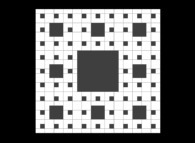
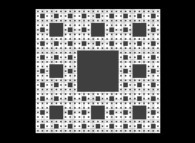
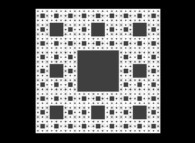
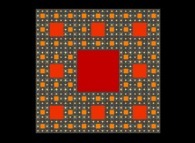
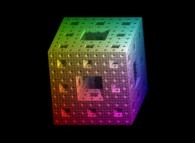
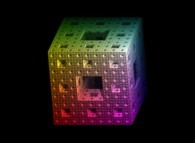
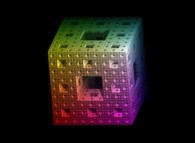
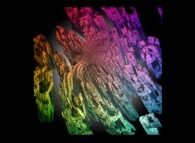
![A parallelepipedic extended Menger Sponge -iteration 4- [Une éponge de Menger généralisée parallélépipédique -itération 4- ]](image.jpg "A parallelepipedic extended Menger Sponge -iteration 4- [Une éponge de Menger généralisée parallélépipédique -itération 4- ]")
A parallelepipedic extended Menger Sponge -iteration 4- [Une éponge de Menger généralisée parallélépipédique -itération 4-].
A parallelepipedic extended Menger Sponge -iteration 4- [Une éponge de Menger généralisée parallélépipédique -itération 4-].


(SubdivisionRules=TTTTT TFTFT TTFTT TFTFT TTFTT TFTFT TTTTT TFTFT FFFFF FTFTF FFFFF FTFTF FFFFF TFTFT TTTTT TFTFT TTFTT TFTFT TTFTT TFTFT TTTTT)
                     log(20)
                    --------- = 2.726833027860842...
                     log(3)
The "standard" Menger sponge can be defined by means of subdivision rules.
Here is the way how each of the 27 cubes of the "standard" Menger sponge at a given level is subdivided:
                   "standard"  Menger sponge
                     _____________________
                    /                     \

                    TTT       TFT       TTT
                    TFT       FFF       TFT
                    TTT       TFT       TTT

                    \_/

             Sierpinski carpet
or again:
TTT TFT TTT TFT FFF TFT TTT TFT TTTwhere 'T' ('True') and 'F' ('False') means respectively "subdivide the current cube" and "do not subdivide and destroy the current cube". The rules are repeated at each level, but they can be changed periodically and for example:
                    TTT TFT TTT  TFT FFF TFT  TTT TFT TTT   FFF FTF FFF  FTF TTT FTF  FFF FTF FFF

                    \___________________________________/   \___________________________________/

                          "standard"  Menger sponge                      complement
alternates the "standard" Menger sponge and its complement.
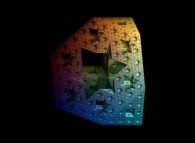
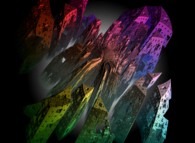
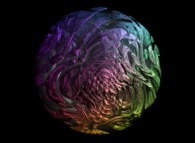
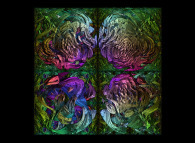
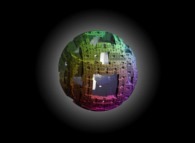
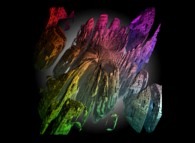
Obviously many other rules do exist as shown below...
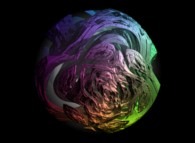
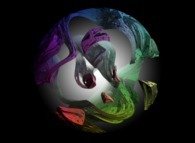
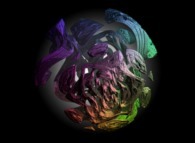
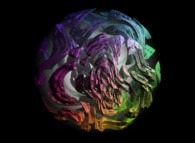
2X - 2Y + 2Z - 1 = 0the origin of the coordinates being at the center of the main cube and the axis being parallel to its sides.
                      3     3     3
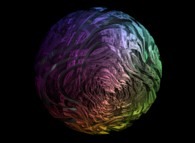
                    2X  - 2Y  + 2Z  - 1 = 0
(the curved one) or again:
                          1  2         1  2         1  2    2
                    (X - ---)  + (Y - ---)  + (Z - ---)  = R
                          2            2            2
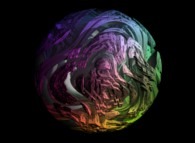
(the spherical one).




 ==>
==> 


 ==>
==> 


 >>>
>>> 

 ==>
==> 
 ==>
==> 

 ==>
==> 
 ==>
==> 
 ==>
==> 
 ==>
==> 


 ==>
==> 
 ==>
==> 
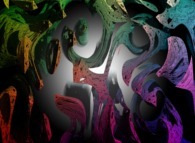


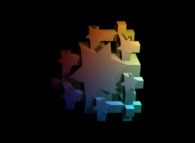


 ==>
==> 


 ==>
==> 


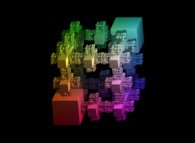 ==>
==> 
 >>>
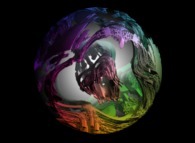
>>> 


 ==>
==> 


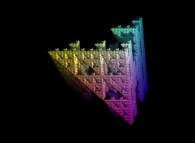 ==>
==> 


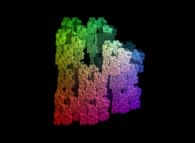 ==>
==> 


 ==>
==> 


 ==>
==> 


 ==>
==> 


 ==>
==> 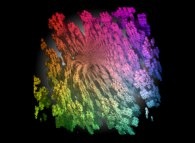 ==>
==> 


 ==>
==> 
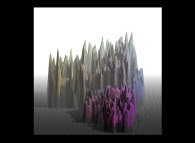


 ==>
==> 


 ==>
==> 


 ==>
==> 

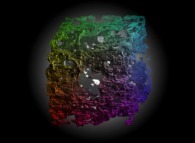


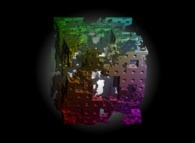


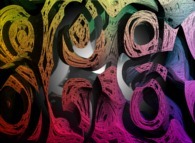
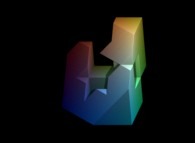
27 digits. Each full cube codes a '1', when each empty/missing one codes a '0'. This picture displays the 27 first digits -base 2- of 'pi' (110 010 010 000 111 111 011 010 101). For example the first triplet "110" appears on the front lower left as two full cubes and an empty/missing one. | 
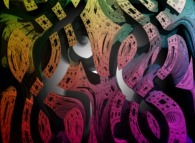
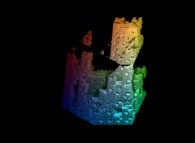
378 digits. | 
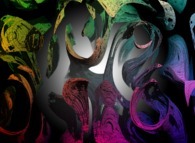
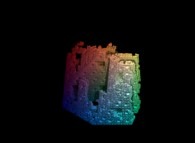
5.508 digits. | 
53.919 digits. | 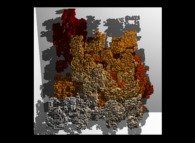
1.168.749 digits. |

15.750.801 digits. | 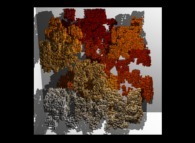
211.210.335 digits. |
                    0 --> F
                    1 --> T

27 digits. Each full cube codes a '1', when each empty/missing one codes a '0'. This picture displays the 27 first digits -base 2- of 'pi' (110 010 010 000 111 111 011 010 101). For example the first triplet "110" appears on the front lower left as two full cubes and an empty/missing one. The first digit ("1") is enhanced using a higher luminance. | 
378 digits. Each full cube codes a '1', when each empty/missing one codes a '0'. This picture displays the 378 first digits -base 2- of 'pi' (110 010 010 000 111 111 011 010 101 000 100 010 000 101 101 000 110 000 100 011 010 011 000 100 110 001 100 110 001 010 001 011 100 000 001 101 110 000 011 100 110 100 010 010 100 100 000 010 010 011 100 000 100 010 001 010 011 001 111 100 110 001 110 100 000 000 100 000 101 110 111 110 101 001 100 011 101 100 010 011 100 110 110 010 001 001 010 001 010 010 100 000 100 001 111 001 100 011 100 011 010 000 000 100 110 111 011 110 111 110 010 101 000 110 011 011 001 111 001 101 001 110 100 100 001 100). The 3x3x3=27 digits following the first digit ("1") are enhanced using a higher luminance. |
                     log(8)
                    -------- = 1.892789260714372
                     log(3)