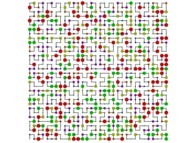
![The Bidimensional [0,1] --> [0,1]x[0,1] Peano Surjection -T defined with 2 digits- [La surjection bidimensionnelle [0,1] --> [0,1]x[0,1] de Peano -T défini avec 2 décimales- ]](image.jpg "The Bidimensional [0,1] --> [0,1]x[0,1] Peano Surjection -T defined with 2 digits- [La surjection bidimensionnelle [0,1] --> [0,1]x[0,1] de Peano -T défini avec 2 décimales- ]")
The Bidimensional [0,1] --> [0,1]x[0,1] Peano Surjection -T defined with 2 digits- [La surjection bidimensionnelle [0,1] --> [0,1]x[0,1] de Peano -T défini avec 2 décimales-].
The bidimensional Peano Surjection:
Giuseppe Peano defined the following surjection
:
[0,1] --> [0,1]x[0,1]
Let's T being a real number defined using the base 3
:
T = 0.A1A2A3... ∈ [0,1] with Ai ∈ {0,1,2}
Let's X(T) and Y(T) being two real functions of T defined as
:
X(T) = 0.B1B2B3... ∈ [0,1] with Bi ∈ {0,1,2}
Y(T) = 0.C1C2C3... ∈ [0,1] with Ci ∈ {0,1,2}
with
:
Bn = A2n-1 if A2+A4+...+A2n-0 is even
Bn = 2-A2n-1 otherwise
Cn = A2n if A1+A3+...+A2n-1 is even
Cn = 2-A2n otherwise
These two functions X(T) and Y(T) are the coordinates of a point P(T) inside the [0,1]x[0,1] square.
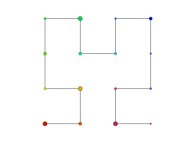
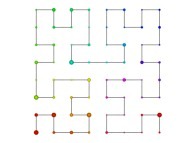
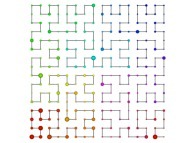
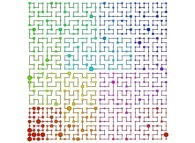
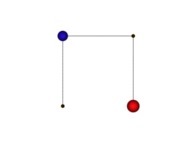
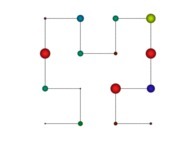
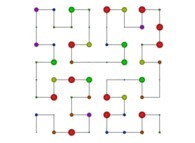
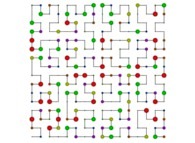
The displayed "curve" -as little spheres- is the trajectory of P(T) when T varies from 0 (lower left corner) to 1-epsilon (upper right corner).
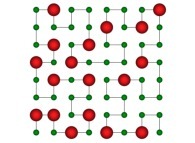
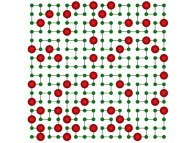
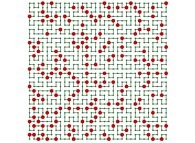
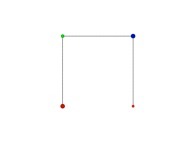
Here are the four first bidimensional Peano curves with an increasing number of digits
{2,4,6,8}:
![The Bidimensional [0,1] --> [0,1]x[0,1] Peano Surjection -T defined with 2 digits-](../../images/PEAN.22.D/timbre.jpg "The Bidimensional [0,1] --> [0,1]x[0,1] Peano Surjection -T defined with 2 digits-")
![The Bidimensional [0,1] --> [0,1]x[0,1] Peano Surjection -T defined with 4 digits-](../../images/PEAN.24.D/timbre.jpg "The Bidimensional [0,1] --> [0,1]x[0,1] Peano Surjection -T defined with 4 digits-")
![The [0,1] --> [0,1]x[0,1] Peano Surjection -T defined with 6 digits-](../../images/PEAN.26.D/timbre.jpg "The [0,1] --> [0,1]x[0,1] Peano Surjection -T defined with 6 digits-")
![The Bidimensional [0,1] --> [0,1]x[0,1] Peano Surjection -T defined with 8 digits-](../../images/PEAN.28.D/timbre.jpg "The Bidimensional [0,1] --> [0,1]x[0,1] Peano Surjection -T defined with 8 digits-") [See the used color set to display the parameter T]
[See the used color set to display the parameter T]
2-The tridimensional Peano Surjection:
A tridimensional surjection can be defined
:
[0,1] --> [0,1]x[0,1]x[0,1]
as a generalization of the bidimensional one.
Let's T being a real number defined using the base 3
:
T = 0.A1A2A3... ∈ [0,1] with Ai ∈ {0,1,2}
Let's X(T), Y(T) and Z(T) being three real functions of T defined as:
X(T) = 0.B1B2B3... ∈ [0,1] with Bi ∈ {0,1,2}
Y(T) = 0.C1C2C3... ∈ [0,1] with Ci ∈ {0,1,2}
Y(T) = 0.D1D2D3... ∈ [0,1] with Di ∈ {0,1,2}
with
:
Bn = A3n-2 if A3+A6+...+A3n-0 is even
Bn = 2-A3n-2 otherwise
Cn = A3n-1 if A2+A5+...+A3n-1 is even
Cn = 2-A3n-1 otherwise
Dn = A3n if A1+A4+...+A3n-2 is even
Dn = 2-A3n otherwise
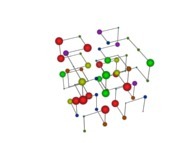
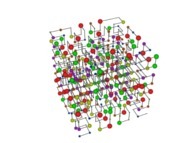
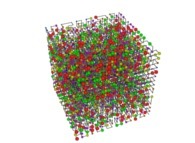
These three functions X(T), Y(T) and Z(T) are the coordinates of a point P(T) inside the [0,1]x[0,1]x[0,1] cube.
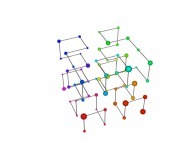
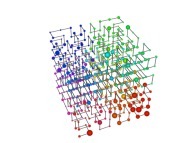
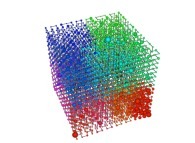
The displayed "curve" is the trajectory of P(T) -displayed as little spheres- when T varies from 0 (lower left corner) to 1-epsilon (upper right corner).
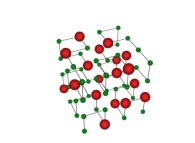
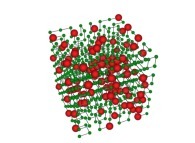
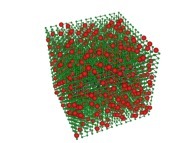
Here are the three first tridimensional Peano curves with an increasing number of digits
{3,6,9}:
![The Tridimensional [0,1] --> [0,1]x[0,1]x[0,1] Peano Surjection -T defined with 3 digits-](../../images/PEAN.12.D/timbre.jpg "The Tridimensional [0,1] --> [0,1]x[0,1]x[0,1] Peano Surjection -T defined with 3 digits-")
![The Tridimensional [0,1] --> [0,1]x[0,1]x[0,1] Peano Surjection -T defined with 6 digits-](../../images/PEAN.13.D/timbre.jpg "The Tridimensional [0,1] --> [0,1]x[0,1]x[0,1] Peano Surjection -T defined with 6 digits-")
![The Tridimensional [0,1] --> [0,1]x[0,1]x[0,1] Peano Surjection -T defined with 9 digits-](../../images/PEAN.14.D/timbre.jpg "The Tridimensional [0,1] --> [0,1]x[0,1]x[0,1] Peano Surjection -T defined with 9 digits-") [See the used color set to display the parameter T]
[See the used color set to display the parameter T]
See various Bidimensional Hilbert and Peano Curves (possibly including this one):
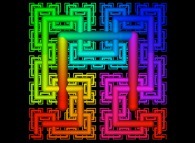
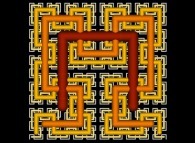
See Bidimensional Hilbert Curves, their nodes being "loaded" with some data (related to prime numbers, real number digits,...):
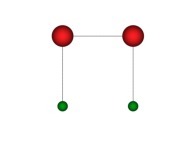
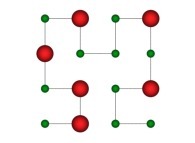
 See the used color set to display the parameter T.
 See the used color set to display the pi digits.
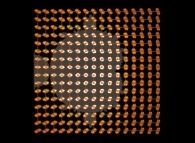

See various Tridimensional Hilbert and Peano Curves (possibly including this one):
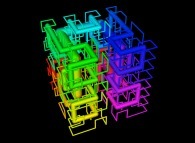
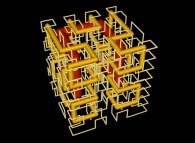
See Tridimensional Hilbert Curves, their nodes being "loaded" with some data (related to prime numbers, real number digits,...):
 See the used color set to display the parameter T.
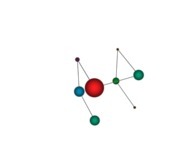
 See the used color set to display the pi digits.
(CMAP28 WWW site: this page was created on 03/24/2022 and last updated on 06/04/2026 23:20:34 -CEST-)
[See the generator of this picture [Voir le générateur de cette image]]
[See all related pictures (including this one) [Voir toutes les images associées (incluant celle-ci)]]
[Please visit the related DeterministicFractalGeometry picture gallery [Visitez la galerie d'images DeterministicFractalGeometry associée]]
[Please visit the related NumberTheory picture gallery [Visitez la galerie d'images NumberTheory associée]]
[Go back toMathematics - A Virtual Instrument For Exploring Space Time And Beyond [Retour à {a chapter of 'Mathematics-AVirtualInstrumentForExploringSpaceTimeAndBeyond'}]]
[The Y2K Bug [Le bug de l'an 2000]]
[Are we ready for the Year 2038 [Notre informatique est-elle prête pour l'An 2038]?]
[Site Map and Help [Plan du Site et Aide]]
[Mail [Courrier]]
[About Pictures and Animations [A Propos des Images et des Animations]]
Copyright © Jean-François COLONNA, 2022-2026.
Copyright © CMAP (Centre de Mathématiques APpliquées) UMR CNRS 7641 / École polytechnique, Institut Polytechnique de Paris, 2022-2026.