click to view the MPEG movie (cliquez pour voir le film MPEG)

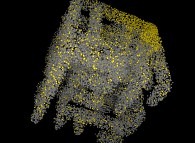
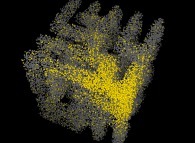
Particle diffusion inside the Hiroko Kitaoka model of the human pulmonary acinus with membrane permeability [Diffusion de particules à l'intérieur du modèle de l'acinus pulmonaire humain du à Hiroko Kitaoka avec perméabilité de la membrane].


This diffusion process takes place inside a medium defined by means of the mathematical model of the smallest scales of the human lung due to Hiroko Kitaoka from the Osaka University Medical School. This model is defined as a space filling tree and in this particular computation, it is built inside a 5x5x5 cubic mesh.

All 29987 particles (grep and orange ones) own exactly the same physical properties except for the interaction with the membrane. The 4969 orange particles are initially close to the tree root; they are created all along the simulation in order to compensate for the ones that are lost due to the permeability of the membrane. The partial pressure of Nitrogen (80%) and of Oxygen (20%) is maintained.

Here are some close-ups of this diffusion process:

Particle diffusion inside the Hiroko Kitaoka model of the human pulmonary acinus with membrane permeability Particle diffusion inside the Hiroko Kitaoka model of the human pulmonary acinus with membrane permeability


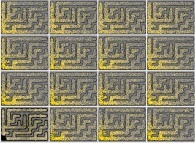
The same model used in a bidimensional space gives a better understanding of the process:

Particle diffusion inside the Hiroko Kitaoka model of the human pulmonary acinus with membrane permeability


(this picture was created on 03/21/2002)
(this page -belonging to the CMAP28 site- was last updated on 03/09/2010 19:13:55 -CET-)


[Please visit the related ParticleSystems picture gallery [Visitez la galerie d'images ParticleSystems associee]]
[Go back to AVirtualSpaceTimeTravelMachine [Retour à AVirtualSpaceTimeTravelMachine]]
[The Y2K bug [Le bug de l'an 2000]]

[Site Map, Help and Search [Plan du Sîte, Aide et Recherche]]
[Mail [Courrier]]
[About Pictures and Animations [A Propos des Images et des Animations]]


Copyright (c) Jean-François Colonna, 2002-2010.
Copyright (c) France Telecom R&D and CMAP (Centre de Mathématiques APpliquées) / Ecole Polytechnique, 2002-2010.