About Real Number Visualization


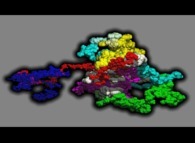
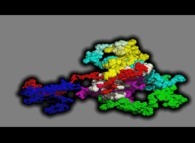
A tridimensional pseudo-random walk -cartesian coordinates- defined by means of the 99.999 first decimals of 'e' (718281...)-base 10- with 33.333 time steps

Jean-François COLONNA
[Contact me]

www.lactamme.polytechnique.fr

CMAP (Centre de Mathématiques APpliquées) UMR CNRS 7641, École polytechnique, Institut Polytechnique de Paris, CNRS, France

[Site Map and Help [Plan du Site et Aide]]
[The Y2K Bug [Le bug de l'an 2000]]
[Are we ready for the Year 2038 [Notre informatique est-elle prête pour l'An 2038]?]
[Real Numbers don't exist in Computers and Floating Point Computations aren't safe. [Les Nombres Réels n'existent pas dans les Ordinateurs et les Calculs Flottants ne sont pas sûrs.]]
[Please, visit A Virtual Machine for Exploring Space-Time and Beyond, the place where you can find more than 10.000 pictures and animations between Art and Science]
(CMAP28 WWW site: this page was created on 06/16/2026 and last updated on 06/18/2026 15:03:09 -CEST-)
[en français/in french]


In both fundamental and applied research, we are accustomed to visualizing the sets of numbers produced by our calculations. These numbers are generally real numbers or rather their crude approximations in the form of so-called floating-point numbers [01][02]. But do we ever try to see the numbers themselves? The continuum, which may appear simple to some, is in fact filled with countless mysteries, and perhaps attempting to represent the entities that inhabit it could help us perceive it more clearly.

The set of real numbers R can be divided into two subsets: on the one hand, the algebraic numbers A [03], and on the other hand, the transcendental numbers T [04]. The set A, obviously contains the integers and, although it is of limited interest [05], they can easily be represented by lengths. Next comes the set of rational numbers Q, and this is where things begin to become more complicated. Indeed, when using base 10, one sometimes obtains simple and finite decimal expansions such as:

1/5 = 0.2

while others are not:

1/7 = 0.1428571428571428571428571428571428571428571428571428571428571428571... ad infinitum

the sequence "142857" repeating indefinitely. The rational number 1/7 is, of course, a solution of the following first-degree equation:

7x - 1 = 0

But what happens when we consider an equation of higher degree, such as:

x2 - x - 1 = 0

The positive solution is φ, the golden ratio:
                               ___
                         1 + \/ 5
                    φ = ----------- ~ 1.6180339887498948482045868343656381177203091798057628621354486227052604628189024497072072041893911374...
                             2
And in this decimal expansion, no obvious pattern can be found...

Finally, when entering the realm of transcendental numbers, it becomes clear that matters will not become any simpler. Thus, as with φ, the decimal expansions of e and π will appear random:

e = 2.7182818284590452353602874713526624977572470936999595749669676277240766303535475945713821785251664274...
π = 3.1415926535897932384626433832795028841971693993751058209749445923078164062862089986280348253421170679... [06]

Can we imagine ways of showing this and, for example, making a visual comparison of the "chaos" of e and π? A solution inspired by Brownian motion is possible. It consists in considering that the successive decimal digits somehow define the motion of a fictitious particle. Obviously, the way of proceeding is arbitrary, and therefore here is one solution among "a thousand" others [07]. Let us consider a sequence of digits, for example:

12345678901234567890...

Based on these digits, we will define three sets: 'DX', 'DY', and 'DZ':

                                             -------> DX = 1               4               7               0               3               6                ...
                                            |               \             / \             / \             / \             / \             / \             /
                                            |                \           /   \           /   \           /   \           /   \           /   \           /
                                            |                 \         /     \         /     \         /     \         /     \         /     \         /
                    12345678901234567890... |-------> DY =     2       /       5       /       8       /       1       /       4       /       7       /
                                            |                   \     /         \     /         \     /         \     /         \     /         \     /
                                            |                    \   /           \   /           \   /           \   /           \   /           \   /
                                            |                     \ /             \ /             \ /             \ /             \ /             \ /
                                             -------> DZ =         3               6               9               2               5               8

which results in:

DX = {1,4,7,0,3,6,...}
DY = {2,5,8,1,4,7,...}
DZ = {3,6,9,2,5,8,...}

These integer values are then normalized again [08], and each triplet {DXi,DYi,DZi} defines the elementary displacement of our fictitious particle at time i.

Here are some examples of such "Brownian-like motions":


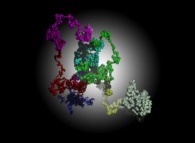
A tridimensional pseudo-random walk -cartesian coordinates- defined by means of the 99.999 first decimals of an arbitrary random number (190496...)-base 10- with 33.333 time steps

A tridimensional pseudo-random walk -cartesian coordinates- defined by means of the 99.999 first decimals of an arbitrary random number (190496...) -base 10- with 33.333 time steps
A tridimensional pseudo-random walk -cartesian coordinates- defined by means of the 99.999 first decimals of the square root of 2 (414213...)-base 10- with 33.333 time steps

A tridimensional pseudo-random walk -cartesian coordinates- defined by means of the 99.999 first decimals of the square root of 2 (414213...) -base 10- with 33.333 time steps
A tridimensional pseudo-random walk -cartesian coordinates- defined by means of the 99.999 first decimals of 'phi' -the golden ratio- (618033...)-base 10- with 33.333 time steps

A tridimensional pseudo-random walk -cartesian coordinates- defined by means of the 99.999 first decimals of 'phi' -the golden ratio- (618033...) -base 10- with 33.333 time steps
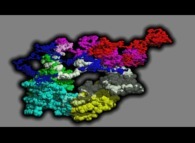
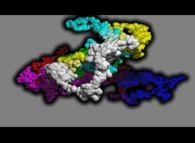
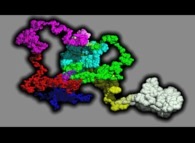
A tridimensional pseudo-random walk -cartesian coordinates- defined by means of the 99.999 first decimals of 'e' (718281...)-base 10- with 33.333 time steps

A tridimensional pseudo-random walk -cartesian coordinates- defined by means of the 99.999 first decimals of 'e' (718281...) -base 10- with 33.333 time steps
A tridimensional pseudo-random walk -cartesian coordinates- defined by means of the 99.999 first decimals of 'pi' (141592...)-base 10- with 33.333 time steps

A tridimensional pseudo-random walk -cartesian coordinates- defined by means of the 99.999 first decimals of 'pi' (141592...) -base 10- with 33.333 time steps


On those pictures, each digit is displayed with a sphere whose radius is a decreasing linear function of its rank i and the arbitrary colors used are also displaying the rank i (from white for the first ones to dark blue for the last ones).


What do we observe? We observe (I deliberately say "observe" rather than "prove"...) that certain algebraic numbers, such as the square root of 2 and φ, look similar to the "classical" transcendental numbers which themselves seem random [09].


Let us finish with a literary reference. In 1985, Carl Sagan [10] published Contact. This novel tells the story of the reception of the first message from outer space, its deciphering, and the "journey to the other end of the galaxy" that follows. Eleanor Arroway, the main character, returns to Earth and, in the final pages of the book, immerses herself in the computation of π in base 11 [11], and around the "decimal" places of rank 1020, she discovers a sequence of "0"s and "1"s which, when considered as a two-dimensional array, forms the image of a "perfect circle", thereby proving, through this "signature of the artist", the "intentional nature of the Universe". Carl Sagan seems to have forgotten (or ignored?) while writing these few lines that π is most probably a normal number, which implies that its digits, whatever the base, contain at least once "all" integers and therefore all possible images [12]... Here is an image:

A tridimensional pseudo-random walk -cartesian coordinates- defined by means of the 99.999 first decimals of 'pi' (141592...)with 492 more digits defining a helix -base 10- with 33.497 time steps

illustrating this. After the first 99,999 decimal digits, 492 "artificial" digits were inserted in order to define a helix, appearing in dark blue, at the bottom left. It should be noted that this helix must actually exist and should eventually appear at least one time, but only at the cost of computational and temporal resources probably incompatible with our Universe...


Copyright © Jean-François COLONNA, 2026-2026.
Copyright © CMAP (Centre de Mathématiques APpliquées) UMR CNRS 7641 / École polytechnique, Institut Polytechnique de Paris, 2026-2026.