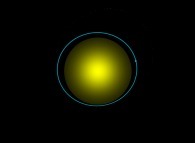
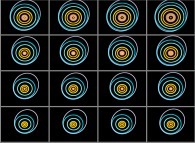
The actual relative sizes of the Solar System bodies [Les tailles réelles relatives des corps du système solaire].
Obviously, the big yellow sphere is the Sun.
When on top of the picture, from left to right, one can find:
{Mercury,the Earth,Mars,Jupiter,Saturn,Uranus,Neptune,Pluto}.
If one try to use the actual scales, in order to see a very dim grey Pluto, one must multiply the actual radius of all
celestial bodies by a huge factor. And then, almost all planets disappear:
The huge size of the Sun prohibits the respect of the actual scales.
In particular, this implies a non linear transformation of the distances:
Each celestial body is colored according to its actual color:
the Sun (bright yellow),
Mercury (orange),
Venus (orange),
the Earth (dark blue),
Mars (red),
Jupiter (orange),
Saturn (yellow),
Uranus (cyan),
Neptune (light blue),
Pluto (grey).
![The actual relative sizes of the Solar System bodies [Les tailles réelles relatives des corps du système solaire ]](image.jpg "The actual relative sizes of the Solar System bodies [Les tailles réelles relatives des corps du système solaire ]")