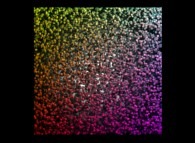
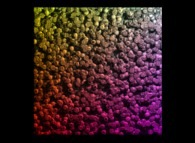
The tridimensional John Conway's life game with random initial conditions -0.3% of occupied cells- and 30 iterations [Le jeu de la vie tridimensionnel de John Conway avec des conditions initiales aléatoires -0.3% de cellules occupées- et 30 itérations ]

The tridimensional John Conway's life game with random initial conditions -0.3% of occupied cells- and 30 iterations [Le jeu de la vie tridimensionnel de John Conway avec des conditions initiales aléatoires -0.3% de cellules occupées- et 30 itérations].


The bidimensional life game was initially defined by Conway. It uses an empty square mesh (all vertices are turned off). At time t=0 some vertices are occupied (they are turned on): this is the initial state. To go from the time t to the time t+1, it suffices to count for each vertex -or "Cell"- C(x,y) the number N of its neighbours (it is less than or equal to 32-1=8) and then to possibly change the state of M according to the following bidimensional automata rules:
                    [R1 = Birth]        ((C(t).IS.off).AND.(N == 3))            ==> C(t+1) on
                    [R2 = Death]        ((C(t).IS.on).AND.((N < 2).OR.(N > 3))) ==> C(t+1) off
                    [R3]                other cases ==> C(t+1)=C(t)
The boundary conditions can be periodical or not.

This process can be extended in a tridimensional space. The number N of neighbours of the vertex -or "Cell"- C(x,y,z) is computed (it is less than or equal to 33-1=26) and the preceding rules can be extended as follows:
                    [R1 = Birth]        ((C(t).IS.off).AND.((N >= NB1).AND.(N <= NB2))) ==> C(t+1) on
                    [R2 = Death]        ((C(t).IS.on).AND.((N < ND1).OR.(N > ND2)))     ==> C(t+1) off
                    [R3]                other cases ==> C(t+1)=C(t)
The bidimensional and tridimensional processes can be extended one step further using two binary lists 'LD' and 'LA' ("Dead" -off- and "Alive" -on- respectively):
                    [R1 = Birth]        ((C(t).IS.off).AND.(LD[N] == 1))  ==> C(t+1)=on
                    [R2 = Death]        ((C(t).IS.on).AND.(LA[N] == 1))   ==> C(t+1)=off
                    [R3]                other cases ==> C(t+1)=C(t)
In the bidimensional case the default 'LD' and 'LA' lists are:
                    LD="000100000"
                    LA="110011110"


For this picture, the tridimensional mesh is 1024x1024x1024 and the parameters have the following arbitrary values:
                    LD="000111111110000000000000000"
                    LA="110000000001111111111111110"


See some related pictures (including this one):

 The tridimensional John Conway's life game with random initial conditions -0.3% of occupied cells- and 10 iterations  
Initial conditions: 0.3% of on cells, 10 iterations.
 The tridimensional John Conway's life game with random initial conditions -0.3% of occupied cells- and 20 iterations  
Initial conditions: 0.3% of on cells, 20 iterations.
 The tridimensional John Conway's life game with random initial conditions -0.3% of occupied cells- and 30 iterations  
Initial conditions: 0.3% of on cells, 30 iterations.
 The tridimensional John Conway's life game with random initial conditions -0.3% of occupied cells- and 40 iterations  
Initial conditions: 0.3% of on cells, 40 iterations.


[More information about the bidimensional John Conway's life game and the bidimensional extended life game]


(CMAP28 WWW site: this page was created on 08/31/2024 and last updated on 06/04/2026 22:42:52 -CEST-)


[See the generator of this picture [Voir le générateur de cette image]]

[See all related pictures (including this one) [Voir toutes les images associées (incluant celle-ci)]]

[Please visit the related NumberTheory picture gallery [Visitez la galerie d'images NumberTheory associée]]

[Go back toMathematics - A Virtual Instrument For Exploring Space Time And Beyond [Retour à {a chapter of 'Mathematics-AVirtualInstrumentForExploringSpaceTimeAndBeyond'}]]

[The Y2K Bug [Le bug de l'an 2000]]
[Are we ready for the Year 2038 [Notre informatique est-elle prête pour l'An 2038]?]

[Site Map and Help [Plan du Site et Aide]]
[Mail [Courrier]]
[About Pictures and Animations [A Propos des Images et des Animations]]


Copyright © Jean-François COLONNA, 2024-2026.
Copyright © CMAP (Centre de Mathématiques APpliquées) UMR CNRS 7641 / École polytechnique, Institut Polytechnique de Paris, 2024-2026.