Virtual Experimentation [A Virtual Space-Time Travel]
CMAP (Centre de Mathématiques APpliquées) UMR CNRS 7641, École polytechnique, Institut Polytechnique de Paris, CNRS, France
france telecom, France Telecom R&D
[Site Map and Help [Plan du Site et Aide]]
[The Y2K Bug [Le bug de l'an 2000]]
[Are we ready for the Year 2038 [Notre informatique est-elle prête pour l'An 2038]?]
[Real Numbers don't exist in Computers and Floating Point Computations aren't safe. [Les Nombres Réels n'existent pas dans les Ordinateurs et les Calculs Flottants ne sont pas sûrs.]]
[Please, visit A Virtual Machine for Exploring Space-Time and Beyond, the place where you can find more than 10.000 pictures and animations between Art and Science]
(CMAP28 WWW site: this page was created on 10/23/1997 and last updated on 06/04/2026 21:39:19 -CEST-)
[en français/in french]
Keywords:
Anaglyphs,
Art and Science,
Artificial Intelligence,
Artistic Creation,
Autostereograms,
Celestial Mechanics,
Computer Graphics,
Deterministic Chaos,
Fractal Geometry,
Generative Artificial Intelligence,
Intertwinings,
Mathematics,
Natural Phenomenon Synthesis,
Numerical Simulation,
Physics,
Picture Synthesis,
Quantum Mechanics,
Rounding-off Errors,
Scientific Visualization,
Sensitivity to Rounding-Off Errors,
Software Engineering,
Stereograms,
Texture Synthesis,
Virtual Experimentation,
Virtual Space-Time Travel.
Science and Techniques translate into
mathematical language the behavior and the
shape of studied systems; a model consists
of a set of equations relating the characteristic
state quantities of the system under study,
such as space-time coordinates, velocity,
temperature, or again pressure. These
equations must be solved analytically
(according to the possibilities: let's recall to
mind that the N-body problem cannot be
solved in this way for N greater than or equal
to 3) or numerically in order to validate the
assumptions and to make predictions. The
most of the time, thanks to faster and faster
computers, these computations create very
large amounts of numerical results.
We define a Virtual Experiment as the
association of the equation solving (according
to some initial values and boundaries
conditions) and of the result analysis.
Eventually, this cycle repeats itself many
times, in the same way that a laboratory
experiment does, when perturbing the initial
conditions, for example... It is noticeable that
this last type of scientific investigation
(historically the first one...) requires more
and more numerical processing, in particular
when the measures are too numerous or occur
at a too high frequency (in particles colliders
or in telescopes for example). Thus rise a
common problem to numerical and laboratory
experimentations: the result analysis.
Except for some exceptional cases, the
produced results are too numerous to be red
alpha-numerically. For example, when
studying the two-dimensional turbulence 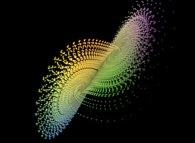 , it is
not uncommon to compute ten millions of
values for each time step, and when
conducting experiments on elementary
particles with high energy accelerators, more
than one million of values can be measured in
less than one second!
Thus, the situation would be
desesperated, if the techniques of Computer
Graphics would not have made great strides,
especially in the artistic field as well as in the
entertainment.
, it is
not uncommon to compute ten millions of
values for each time step, and when
conducting experiments on elementary
particles with high energy accelerators, more
than one million of values can be measured in
less than one second!
Thus, the situation would be
desesperated, if the techniques of Computer
Graphics would not have made great strides,
especially in the artistic field as well as in the
entertainment.
Vision (ie. the sense by which the
qualities of an object constituting its
appearance are perceived) is probably at the
origin of insatiable mankind's curiosity and
of scientific research. It is the most
"advanced" natural way to catch close and
distant environments. With his eyes and
visual cortex, man can extract complex
colored patterns from a moving, changing
and noisy context. Thus it is a natural idea to
use the whole sense of sight for result
analysis; The numerical results will be
displayed to users (scientists or engineers) as
animated pictures, and then exploited by their
eyes, and maybe tomorrow with the help of
pattern recognition systems as it is common
today in the picture processing field.
Picture is a tool for synthesis: it
provides a global presentation of results. It
will facilitate the comparison between "natural
phenomena" (measures) and their simulations
(numerical results). It will generate concrete
representations for abstract concepts.
Generally, these visualizations will be
arbitrary ones; but they will facilitate
experiments in domains like pure
mathematics 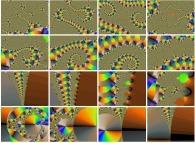
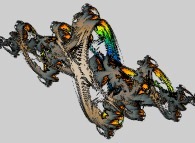 . Microscope has shown us the
infinitely small, telescope, the infinitely big
and computer, providing that we are
developing adequate and accurate models, is
going to open our eyes to "new universes":
maybe, a new Copernician revolution is just
starting... Computer Graphics enables us to
watch at modelized phenomena that are too
fast
. Microscope has shown us the
infinitely small, telescope, the infinitely big
and computer, providing that we are
developing adequate and accurate models, is
going to open our eyes to "new universes":
maybe, a new Copernician revolution is just
starting... Computer Graphics enables us to
watch at modelized phenomena that are too
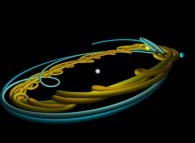
fast 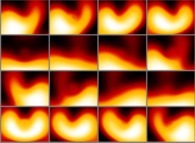 , too small or again too far
 (in space-time)
to be shown directly by other instruments.
But moreover, it enables us to access or to
manipulate laboratory inaccessible
phenomena. The dream comes true: we have
acces to the (virtual) space-time travel
machine!
(in space-time)
to be shown directly by other instruments.
But moreover, it enables us to access or to
manipulate laboratory inaccessible
phenomena. The dream comes true: we have
acces to the (virtual) space-time travel
machine!
Thus, a travel from the infinitely small to the infinitely big
becomes possible: we can reach the Quantum Mechnanics World
, or the
most abstract structures 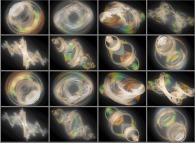 , or again
imaginary worlds reflecting our own Reality
, or again
imaginary worlds reflecting our own Reality 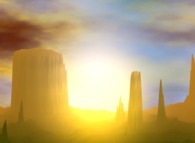 and finally, cosmic scales that defy our imagination .
Computer Graphics is one of the best
way to concile (or, better, to reconcile) today
Art and Science 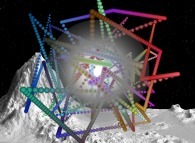 . As a matter of fact,
techniques needed to produce realistic
documents, ie. misusing human senses are
highly scientific (ie. make use of
mathematics, fluid dynamics, hierarchical
systems,...). Moreover, Scientific
Visualization is a communication tool: then it
must be "optimized"; thus, it must abide by
great (and old...) artistic laws about
proportions and chromatic harmonies
. As a matter of fact,
techniques needed to produce realistic
documents, ie. misusing human senses are
highly scientific (ie. make use of
mathematics, fluid dynamics, hierarchical
systems,...). Moreover, Scientific
Visualization is a communication tool: then it
must be "optimized"; thus, it must abide by
great (and old...) artistic laws about
proportions and chromatic harmonies 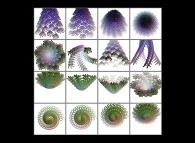 .
Today, Computer Graphics is a mature
technique. Thus, it can be used by scientists
as a really productive tool. But it requires
consideration: it is very important to put
scientists on their guard against non
informative aestheticism: "beautiful" and
"informative" are not synonym
.
Today, Computer Graphics is a mature
technique. Thus, it can be used by scientists
as a really productive tool. But it requires
consideration: it is very important to put
scientists on their guard against non
informative aestheticism: "beautiful" and
"informative" are not synonym 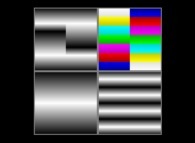 !
!
In more general terms, most of our
today Science and Techniques rely on
computers; unfortunately and despite our
beliefs, theses machines are unreliable and
bounded. Their unreliability finds its root in
the way programs are written; their limit (in
the scientific context) comes from the very
simple fact that real numbers cannot be
represented and manipulated inside a digital
machine 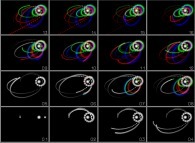 ! The consequence of these two
negative properties is that this fantastic tool
must be used very carefully; unfortunately,
the today tendency is to replace the cogito ergo sum
with a "computo" ergo sum...
! The consequence of these two
negative properties is that this fantastic tool
must be used very carefully; unfortunately,
the today tendency is to replace the cogito ergo sum
with a "computo" ergo sum...
Copyright © Jean-François Colonna, 1997-2026.
Copyright © France Telecom R&D and CMAP (Centre de Mathématiques APpliquées) UMR CNRS 7641 / École polytechnique, Institut Polytechnique de Paris, 1997-2026.